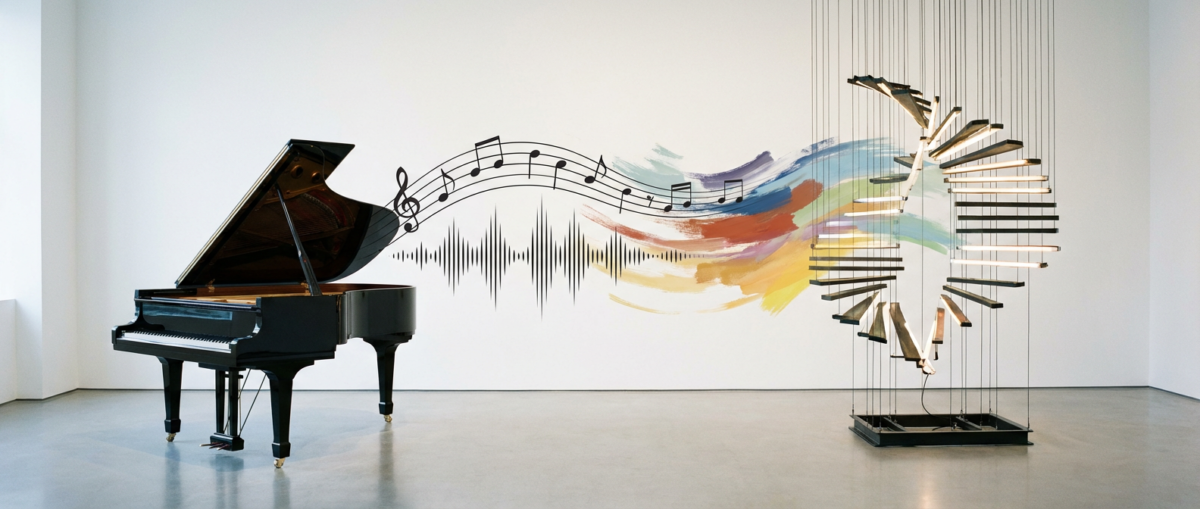
The Moment Sound Becomes Color
I was standing in front of Kandinsky’s “Composition VII” at the Tretyakov Gallery when the security guard hummed a few bars of Bach under his breath. Suddenly, those swirling forms and explosive color patches weren’t just paint anymore. They were following the same mathematical progressions, the same push and pull of tension and release that made the guard’s melody so satisfying. The painting had rhythm. Once I heard it, I couldn’t unsee the music in every brushstroke.
This wasn’t coincidence. Kandinsky, like many artists working in the early 1900s, believed that color had sound and that visual art could achieve the same emotional directness as music. He called it “spiritual resonance,” but what he was really describing was synesthesia. You know, that weird neurological thing where hearing a sound automatically triggers colors, or seeing certain shapes makes you taste metal. When Kandinsky painted those famous circles in bright yellows and deep blues, he was translating what it felt like to hear music into something the rest of us could see.
Jazz Rhythms in Mondrian’s Grid
Piet Mondrian’s geometric abstractions might seem worlds away from the smoky jazz clubs of 1920s New York, but look closer at his “Broadway Boogie Woogie” and you’ll hear those syncopated rhythms that turned American music upside down. Those small squares of red, yellow, and blue aren’t randomly placed. They follow the same off-beat patterns that made boogie-woogie piano so addictive.
Mondrian spent his final years in Manhattan, and the city’s energy seeped into his work in ways nobody expected. He stopped using black lines entirely. Instead, he used colored rectangles that seem to flicker and dance across the canvas. The painting captures the stop-and-start rhythm of city traffic, the irregular pulse of neon signs, and yes, the musical innovations happening in Harlem nightclubs. Each color square is a beat, a note, a moment where what you see and what you hear merge into something completely new.
This connection between jazz and abstract art wasn’t just Mondrian’s thing. Stuart Davis, working in America around the same time, created paintings that looked exactly like jazz sounded. Angular, improvisational, full of unexpected color combinations that somehow worked perfectly together. His “Swing Landscape” from 1938 translates the experience of listening to Count Basie into bold geometric shapes that seem to move right off the wall.
The Color Theory Revolution
The relationship between music and visual art runs deeper than individual artists getting inspired by whatever was playing on the radio. Both art forms experienced parallel revolutions in how they understood their basic building blocks. Just as composers in the early 20th century began experimenting with atonal music and completely new harmonic structures, painters were discovering that color could function independently of representation.
Josef Albers, working at the Bauhaus school in Germany, developed color studies that operated like musical scales. His famous “Homage to the Square” series explores how colors influence each other when placed side by side. It’s the visual equivalent of harmonic intervals in music. A yellow square nested inside an orange one creates a different “chord” than the same yellow surrounded by blue. Albers taught students to see color relationships the way musicians hear chord progressions, as systems of tension and resolution that either work or they don’t.
This wasn’t just theoretical classroom stuff. Albers collaborated directly with composers, including his colleague John Cage, to create performances where color changes accompanied musical phrases. Their work at Black Mountain College in the 1950s established the foundation for all the multimedia art we take for granted today. When you watch a concert where lighting design responds to the music, you’re experiencing the legacy of these early experiments.
Street Art Finds Its Beat
Walk through any major city today and you’ll see this music-visual art connection playing out on walls, underpasses, and subway platforms. Hip-hop culture emerged in the 1970s with four distinct elements: DJing, MCing, breaking, and graffiti. They’ve remained connected ever since. The visual rhythms of a well-executed piece mirror the layered samples and beats that define hip-hop production.
Graffiti artists like FUTURA 2000 and Rammellzee understood this instinctively. Their letter-based abstractions don’t just spell words. They create visual music, with each letter functioning like an instrument in an ensemble. The way colors flow into each other, the repetition of certain shapes, the careful balance of thick and thin lines—it all follows principles that any DJ would recognize from mixing tracks.
Contemporary street artists continue this tradition, but with expanded tools and techniques. Take the work of Os Gemeos, twin brothers from São Paulo whose large-scale murals incorporate the rhythmic complexity of Brazilian music into their visual compositions. Their figures seem to dance across building walls, frozen mid-movement in poses that capture the syncopated energy of samba and bossa nova.
Finding the Beat in Your Local Gallery
The next time you visit a museum or gallery, try listening to the art instead of just looking at it. Pay attention to repetition—the way brushstrokes create visual rhythms, how color patterns establish and then break expectations. Notice which artworks feel fast or slow, which ones seem to have complex polyrhythms and which ones follow simpler, more predictable beats.
This isn’t about finding hidden meanings or proving that artists secretly embedded musical codes in their work. It’s about recognizing that human perception operates across multiple channels simultaneously. Great art often succeeds because it engages more than one sense at a time. When you start to hear the music in visual art, you’re not just being creative. You’re tapping into the same neurological processes that made Kandinsky’s circles dance and gave Mondrian’s grids their boogie-woogie swing.
Here’s something fun to try: bring headphones to your next gallery visit and experiment with different soundtracks while viewing the same pieces. You’ll be amazed how dramatically the music changes what you see, and how certain combinations reveal visual rhythms you never noticed before. Just don’t blame me when you start seeing Beethoven’s symphonies in every Rothko painting.