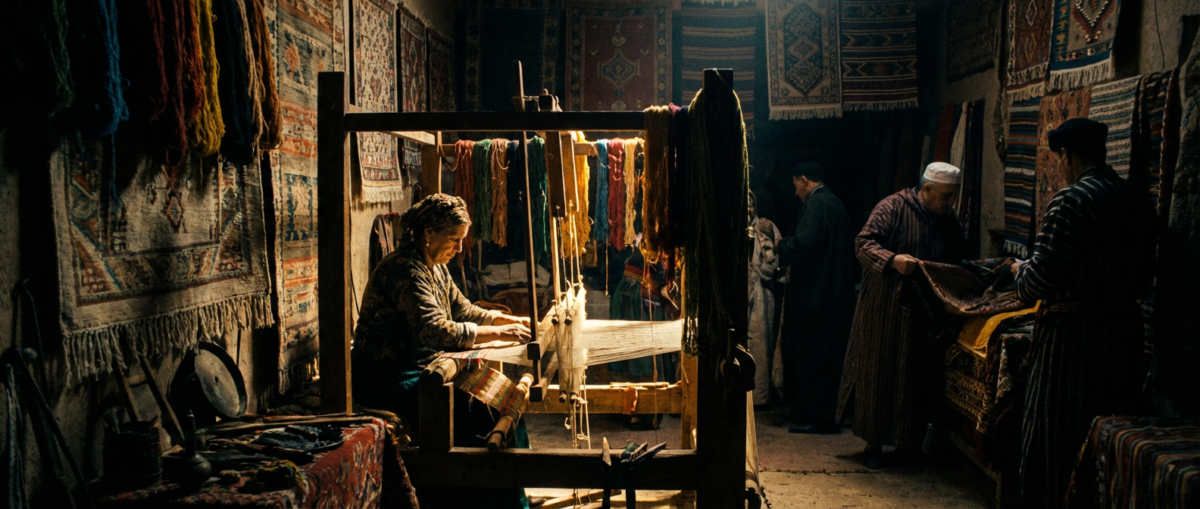
The Loom as Time Machine
In a sunlit studio in Santa Fe, Ramona Sakiestewa sits before a massive floor loom, her fingers moving in the same rhythm her Hopi grandmother taught her sixty years ago. The warp threads stretch taut, vertical lines that have remained unchanged since ancient Pueblo weavers first pulled cotton from the earth. But the pattern emerging beneath her hands tells a different story entirely. Geometric forms in deep indigo and rust red create a composition that would feel at home in a Mondrian painting, yet every motif carries the weight of centuries-old symbolism.

This is where textile arts live today. Not in museums under glass, but in the active spaces where contemporary artists engage with cultural traditions that stretch back millennia. These artists understand something that many contemporary art movements miss: innovation doesn’t require abandoning the past. You can find new ways to speak through tradition instead.
Sakiestewa pauses to adjust a thread that has gone slack. “People think tradition means doing exactly what your ancestors did,” she says, her voice carrying the same measured cadence as her weaving. “But tradition is a conversation across time. My grandmother wove to clothe her family. I weave to clothe ideas.”

The Global Thread
Walk into any major contemporary art fair today and you’ll find textile work that defies easy categorization. In New York galleries, Ghanaian artist El Anatsui’s massive metal cloth sculptures cascade from walls like liquid gold, each piece constructed from thousands of discarded bottle caps and aluminum strips. The technique echoes traditional kente weaving patterns, but the materials speak to contemporary concerns about consumption and waste. It’s beautiful and unsettling at once.
Meanwhile, in Mexico City, artist Tanya Aguiñiga creates large-scale installations using traditional Oaxacan weaving techniques combined with industrial materials. Her recent piece at the Museum of Contemporary Art has hand-woven sections made from plastic bags collected from the US-Mexico border, each strand carefully cleaned and processed using methods passed down through generations of indigenous weavers. The result forces viewers to reconsider both the value of traditional craft knowledge and the reality of contemporary migration.
These artists represent a larger movement that’s reshaping how we think about cultural heritage in art. They’re not appropriating traditions from other cultures, but rather mining their own ancestral knowledge for contemporary relevance. The distinction matters enormously. It creates space for authentic voices while avoiding the pitfalls of cultural tourism that have plagued textile arts in commercial contexts.
Threads of Resistance
The political power of textile work becomes most apparent when you understand its historical context. In many cultures, weaving was women’s work, which meant it was both essential and undervalued. Colonial powers often targeted textile traditions as a way of disrupting cultural identity. The British systematically destroyed India’s cotton industry to protect their own markets. Spanish colonizers banned indigenous weaving patterns in the Americas, recognizing their role in maintaining cultural memory.
Today’s textile artists understand this history in their bones. When Pakistani-American artist Anila Quayyum Agha creates delicate paper installations that cast geometric shadows reminiscent of Islamic patterns, she’s not just making beautiful objects. She’s reclaiming visual languages that have been marginalized or misunderstood in Western contexts. Her piece “Intersections” fills entire gallery spaces with shifting patterns of light and shadow, inviting viewers to move through spaces that feel both ancient and futuristic.
When Hmong-American artist Koua Her incorporates traditional paj ntaub needlework into large-scale contemporary pieces, she’s addressing the messy realities of displacement and cultural preservation. Her work appears in major museums now, but it emerges from techniques her mother used to create story cloths documenting their family’s journey from Laos to American refugee camps. Each stitch carries both aesthetic and historical weight.
The Contemporary Renaissance
What strikes me about this current moment in textile arts is how it’s pulling in artists who might have previously worked in more traditionally “fine art” media. Painter Kerry James Marshall has begun incorporating fabric and thread into his work, drawing on the quilting traditions of his grandmother while maintaining his distinctive visual style. The combination creates layers of meaning that neither medium could achieve alone.
The rise of social media has also changed access to traditional techniques in ways we’ve never seen before. Young artists in urban centers can now learn traditional weaving methods through online communities that connect them directly with master practitioners from around the world. This direct transmission bypasses the academic institutions that historically controlled access to art education, creating space for more diverse voices and approaches.
Museums are paying attention. The Whitney Museum’s recent exhibition “Pacha, Llaqta, Wasichay: Indigenous Space, Modern Architecture, and Art” put contemporary Andean textile work alongside architectural installations, acknowledging the sophisticated spatial and mathematical concepts embedded in traditional weaving practices. The Metropolitan Museum of Art has expanded its textile galleries to include more contemporary work, recognizing that the line between historical artifact and living tradition is more blurred than previous curatorial approaches suggested.
Weaving Forward
The artists working at the intersection of traditional textile practices and contemporary art are doing more than creating beautiful objects. They’re proving that cultural preservation and innovation can coexist, that ancient techniques can speak to urgent contemporary concerns, and that the hands that have always made the cloth can also reshape the art world’s understanding of what counts as serious artistic practice.
As Sakiestewa works in her Santa Fe studio, creating pieces that will hang in major museums, she’s part of something larger than her individual artistic practice. She’s connected to a global community of makers who understand that the future of art doesn’t mean abandoning the past, but finding new ways to honor and extend it. The threads they weave today will become the traditions that future artists inherit, adapt, and transform in their own time.
Next time you encounter textile work in a gallery or museum, take a moment to consider the conversations happening across time through those threads. Look closely at how traditional techniques create space for contemporary ideas, how ancient patterns speak to current concerns, how the act of making connects us to both past and future in ways that pure conceptual art rarely achieves.