
The Arithmetic of Absence
Late 2025 brought something to the Museum of Modern Art that should have arrived decades earlier: a comprehensive Jean-Michel Basquiat retrospective. Over two hundred works spanning the entirety of his brief but explosive career—from 1980 through 1988—finally occupied the kind of institutional real estate typically reserved for the safely canonized dead. The show is significant, a full accounting of what he made during those eight years when he transformed from a graffiti prodigy into a painter who forced the entire art world to reckon with its own blindness. But here’s the uncomfortable arithmetic: Basquiat died in 1988 at twenty-seven, which means this major retrospective arrived nearly four decades after his death. Four decades. That gap tells us something far more revealing than any critical essay could.
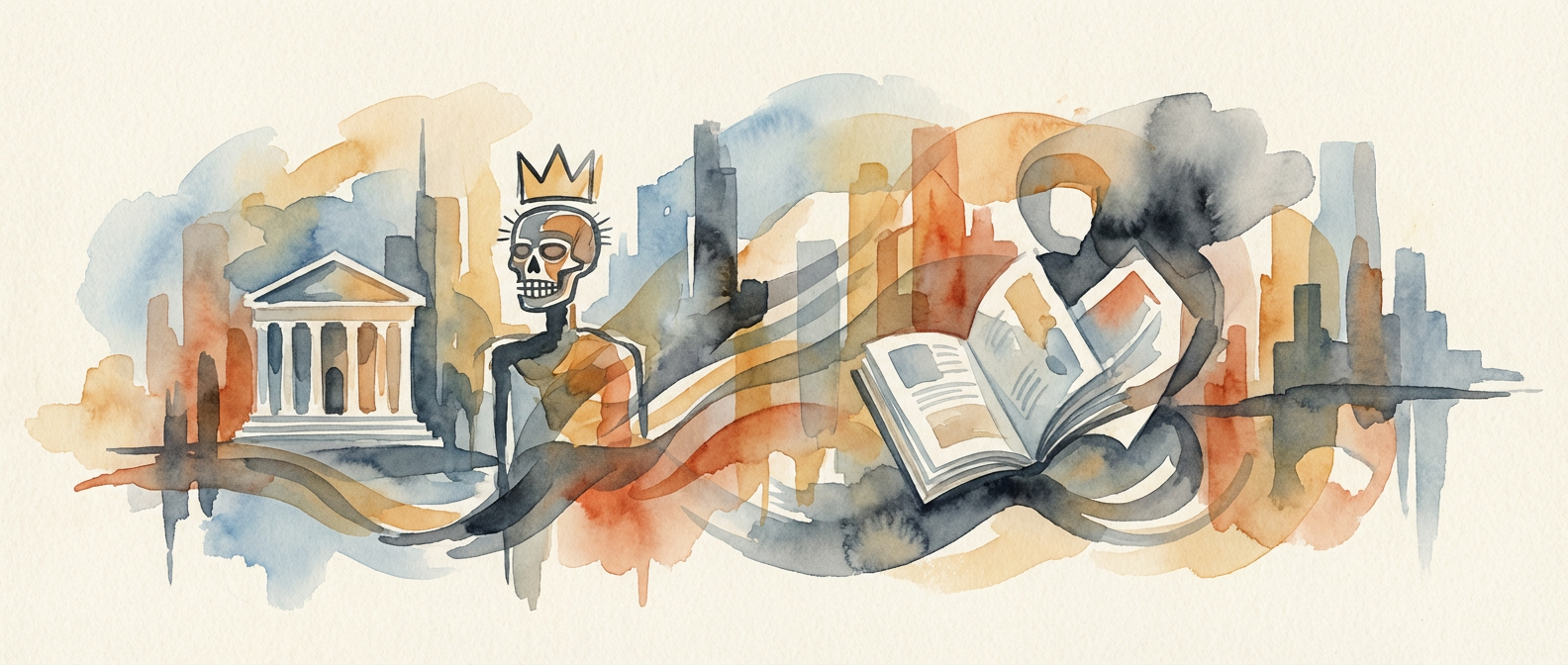
The delay wasn’t born of lack. Basquiat’s market value has long announced his importance in the clearest language capitalism speaks. His untitled 1982 painting sold for $110.5 million at Sotheby’s in 2017, the highest price ever paid at auction for any American artist. Museums worldwide hold his work. Collectors pursue it with the single-mindedness usually reserved for religious relics. Yet MoMA, the institution that could have positioned itself as the authoritative voice on Basquiat decades ago, waited. And waited. This isn’t negligence exactly. It’s something more structural, more telling about how museums navigate the art historical canon when that art comes attached to a Black body, to street culture, to the anxieties of the mainstream art world.

The Catalog as Conversation
The retrospective’s accompanying catalog, published by MoMA Press at four hundred pages, reads as something between confession and correction. Newly commissioned essays from scholars including Kellie Jones offer fresh interpretive frameworks for works that have been studied, bought, sold, and resold countless times already. You can feel the institution finally deploying its full scholarly apparatus toward an artist it had, in a meaningful way, neglected. The catalog isn’t a simple celebration. It reads as an extended meditation on what Basquiat’s work has always been asking us to see: the systems of power encoded in representation, the violence of exclusion, how artistic genius gets filtered through the machinery of institutional legitimacy.
What strikes me most when moving through Basquiat’s paintings is how little the work needs institutional endorsement, and how much it reveals about institutions that withhold it. His compositions draw from medieval manuscript illumination, anatomical texts, street signage, advertising language, and the visual vocabulary of Black vernacular culture. He builds meaning in layers, creating a visual shorthand for how knowledge gets organized, who gets to speak, whose voice gets heard. When you stand before these paintings—and you should, if you have any chance—you see immediately that Basquiat understood composition, color, and the weight of line in ways that connect back through the entire history of painting. He wasn’t a self-taught primitive discovering art accidentally. He was a painter working in conscious dialogue with artistic traditions, including especially the traditions that institutional museums had trained him to study.
The Numbers That Demand Interrogation
The broader context matters enormously. An Artnet Intelligence Report on museum diversity examined acquisition patterns at major U.S. museums between 2008 and 2023 and found that Black artists comprised only 1.2 percent of works acquired during that fifteen-year period. One point two percent. We’re living in a moment when those numbers have become increasingly visible, when institutions have begun publicly acknowledging their historical failures in representation. But these failures didn’t happen by accident. They were the product of repeated choices, institutional practices that valued certain aesthetics and certain bodies as more intrinsically worthy of preservation and study. Basquiat’s market triumph happened almost in spite of these institutional barriers, not because they fell away.
This is precisely what makes the MoMA retrospective so complicated to evaluate. The show is genuinely important. The scholarship is serious. The curation deserves attention and thought. But it arrives in a moment when the art market has already decided Basquiat’s value, when collectors have already bid his prices into the stratosphere, when the work has already proven itself commercially viable in ways that once seemed impossible. The retrospective doesn’t, can’t, correct the decades of institutional neglect. It acknowledges them. There is a difference.
What the Paintings Have Always Known
Yet here is where I resist the easy cynicism. The paintings themselves remain extraordinary. Standing before them, you feel the compression of visual knowledge, the urgent handwriting, the references piling up like palimpsest. Basquiat worked with the speed of someone who understood that time was short, that there was too much to say and not enough years to say it. Looking at these works now, as historical objects, we see more clearly what they were always attempting: a visual vocabulary for the experience of being hyperaware, of moving through systems designed to exclude you, of drawing from everything available, high art, low culture, medical texts, poetry, and making something entirely new from the collision.
MoMA’s official Basquiat exhibition page has the practical details: hours, dates, related programming. But the real question is what you do with the experience once you have it. The retrospective exists as both genuine achievement and mild institutional apology. Both things are true at once. Museums aren’t monoliths; they’re spaces where real scholarship and institutional blindness coexist. Our job as viewers is to move through these spaces with our eyes open, to notice what the paintings are doing, to ask ourselves what it means that we waited so long to clear wall space for genius that was always, unmistakably there.
The Elegy and the Afterlife
In the end, maybe this is Basquiat’s final gift to us: he teaches us to read the systems we inhabit, to see how power gets distributed, claimed, and withheld. The retrospective will close. The paintings will disperse back into private collections and other museums. But the catalog will remain, the scholarship will hold, and the work itself, that glorious, unsettled, endlessly generative work, keeps doing what it has always done. It insists on being taken seriously. It refuses diminishment. It demands that we look harder at the structures around us and ask why it took so long to see.
If you have thoughts about what this retrospective means for you—whether it changed how you see Basquiat’s work, whether you think institutional recognition matters, whether the timing feels redemptive or hollow—I’d genuinely love to hear it. Understanding art isn’t something curators finish. It’s something we all do together, across time, across galleries, in conversation with one another.