The Foundation That Outlasts Trends
When I think about the great watercolorists who shaped how we see light and transparency—from Turner’s revolutionary atmospheric studies to Winslow Homer’s maritime masterpieces—I often focus on their genius, their vision, their ability to capture fleeting moments in pigment and water. What I sometimes forget is that each of these artists began with the same fundamental question every watercolor painter faces: which tools will serve my artistic voice for decades to come?
The beauty of watercolor lies not in complexity but in the profound relationships between a few simple elements. Unlike oil painting with its endless array of mediums and supports, or sculpture with its specialized tools for each material, watercolor painting asks for restraint, for thoughtful selection. The masters understood this. They built their reputations not on rooms full of equipment, but on intimate knowledge of paper that could hold their vision, brushes that became extensions of their hands, and pigments that would sing in harmony with water.
This restraint becomes a gift to the beginning painter. Where other mediums might overwhelm with options, watercolor offers clarity. The essential tools are few, but each carries weight, each demands understanding, each offers a lifetime of discovery. Think of how Georgia O’Keeffe worked with the same basic watercolor setup for decades, yet continued to find new ways to express the essence of flowers, landscapes, and light.

Paper as Partner, Not Merely Support
In the hierarchy of watercolor materials, paper reigns supreme. This isn’t mere practicality, it’s poetry. The paper you choose becomes your collaborator, affecting every decision that follows. Cold-pressed watercolor paper, with its subtle texture, holds water in its gentle valleys while allowing pigment to settle into patterns that would be impossible on smooth surfaces. This texture is what gives watercolor paintings their characteristic glow, the way light seems to bounce from within the painting itself.
Weight matters more than beginning painters often realize. Papers of 140 pounds or heavier resist the warping that can frustrate early attempts and ruin careful compositions. When you watch watercolor paper cockle under a heavy wash, you’re seeing physics in action—cellulose fibers expanding and contracting with moisture. Quality papers are sized to control this absorption, creating a surface that accepts pigment willingly while maintaining structural integrity.
I recommend investing in paper as you would in any relationship meant to last. Brands like Arches, Fabriano, and Winsor & Newton have built reputations over centuries, not decades. Their papers age gracefully, holding color true over time. When you work on quality paper, you’re not just making a painting, you’re creating something that could outlast you, something that future generations might discover and treasure.
Brushes That Become Extensions of Intent
The mythology around expensive brushes often intimidates beginners, but the truth is more complex. Yes, a quality brush holds more water, maintains its point longer, and responds predictably to pressure. But the real magic happens in the relationship between painter and brush, developed through countless hours of practice. Even Sargent’s legendary facility with watercolor came not from his brushes alone, but from his understanding of how water, pigment, and hair interact.
A basic toolkit should include three brushes that cover the fundamental techniques of watercolor. A large round brush—size 12 or 14—becomes your workhorse for washes and bold strokes. Its ability to hold substantial amounts of water makes it essential for the flowing, continuous marks that give watercolor its distinctive character. A medium round brush, perhaps size 6 or 8, handles the majority of your painting, offering precision without sacrificing water capacity. A small detail brush completes the trio, though many accomplished watercolorists use their medium brush for details, proving that skill often matters more than specialized tools.
Natural hair brushes, particularly those made from kolinsky sable, have dominated watercolor painting for good reason. The structure of the hair creates tiny reservoirs that hold water and pigment, releasing them gradually as you paint. Synthetic brushes have improved dramatically in recent decades, offering consistent performance at lower costs. The key is choosing brushes that spring back to their original shape after each stroke, maintaining the point or edge that allows for controlled mark-making.
Pigments That Sing in Water
Color selection reveals personality perhaps more than any other choice in watercolor painting. The palette that works best for you will evolve with your artistic voice, but certain pigments have earned their place in the watercolor tradition through centuries of proven performance. Ultramarine blue offers the deep, resonant blues that anchor so many compositions. Burnt sienna provides the warm earth tones that ground landscapes and portraits alike. Cadmium yellow brings brightness that seems to glow from within.
Student-grade versus artist-grade pigments is one of the most significant decisions facing beginning painters. Artist-grade pigments contain higher concentrations of pure pigment, offering more intense colors and better lightfastness. They also cost significantly more. The compromise many successful painters have found involves investing in artist-grade versions of the colors they use most frequently—often the primary colors plus a few earth tones—while using student-grade pigments for mixing and experimental work.
Transparency becomes important in watercolor in ways that don’t apply to other painting mediums. Pigments like quinacridone rose and phthalo blue maintain their clarity even in multiple layers, allowing for the glowing effects that make watercolor so distinctive. Opaque pigments like cadmium yellow and titanium white have their place, but understanding which pigments remain transparent helps you make informed decisions about color mixing and layering.
The Quiet Essentials That Complete the Journey
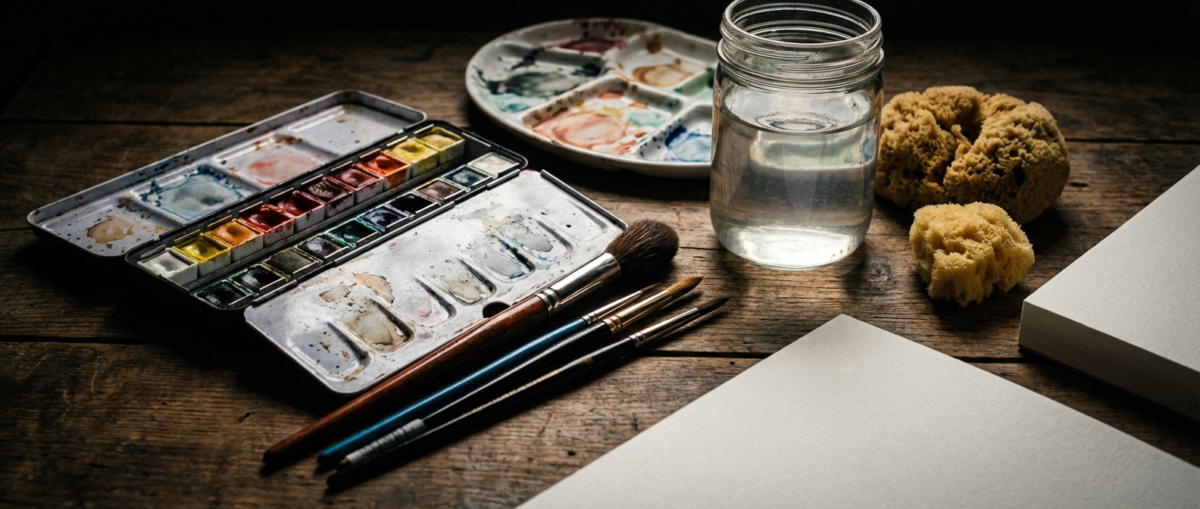
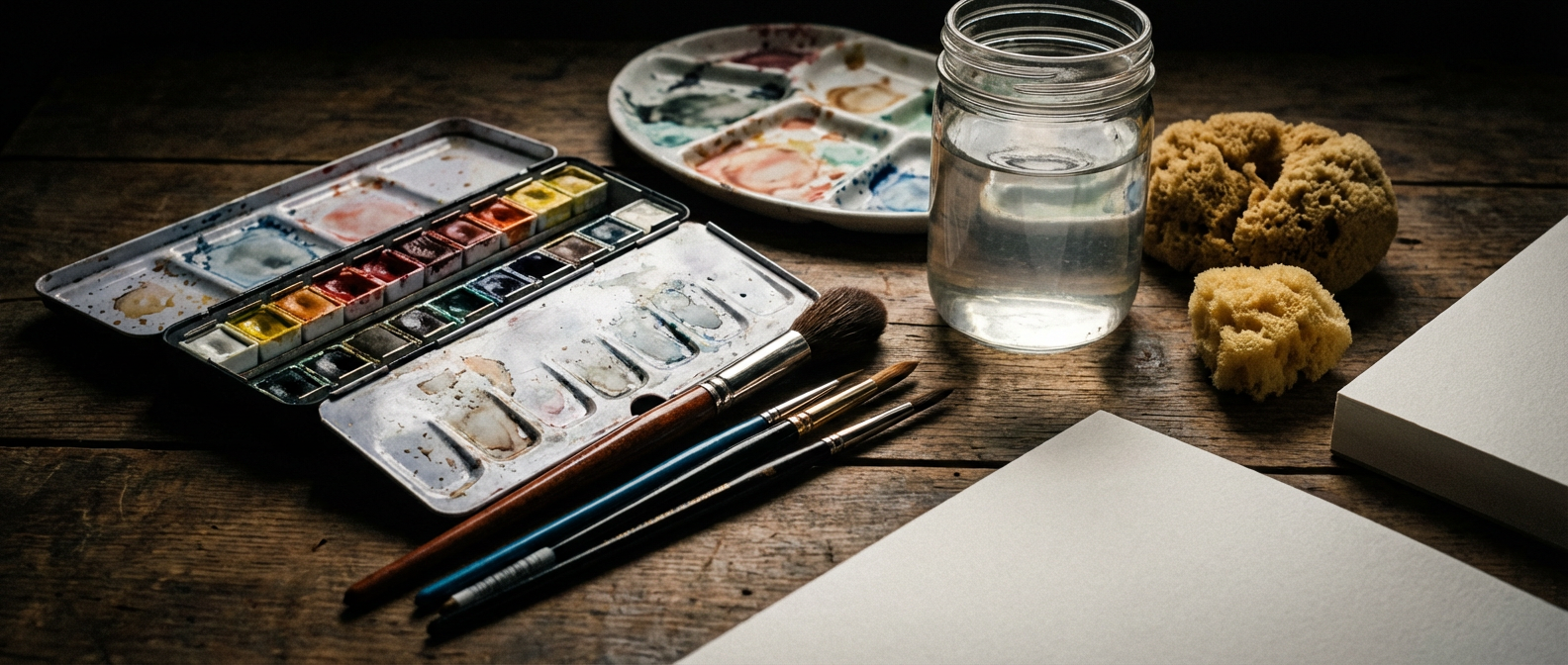
Beyond the holy trinity of paper, brushes, and pigments lie the smaller tools that support the watercolor process. A palette for mixing colors need not be expensive—a simple white ceramic plate works better for many professional painters than elaborate mixing systems. The key is having sufficient space for clean mixing and the ability to see color relationships clearly. Natural sponges help with texture effects and paint removal, while their synthetic counterparts offer more controlled absorption.
Water containers deserve more thought than they typically receive. Two jars—one for clean water, one for rinsing brushes—prevent muddy mixes and maintain color clarity. The size matters. Larger containers stay cleaner longer and provide more consistent water quality throughout painting sessions. Masking tape and masking fluid preserve white areas and create clean edges, though many watercolorists prefer the organic edges that come from careful brush control.
Perhaps most importantly, remember that these tools work for your vision, not the other way around. The greatest watercolorists in history shared not expensive equipment, but deep understanding of their materials and unwavering commitment to their craft. Your toolkit will evolve as your skills develop, as your artistic interests shift, as you discover new techniques and approaches. Start with quality basics, learn them thoroughly, and add complexity only as your artistic voice demands it. The work you build will rest not on the tools themselves, but on how completely you master their possibilities.