The Delayed Homecoming
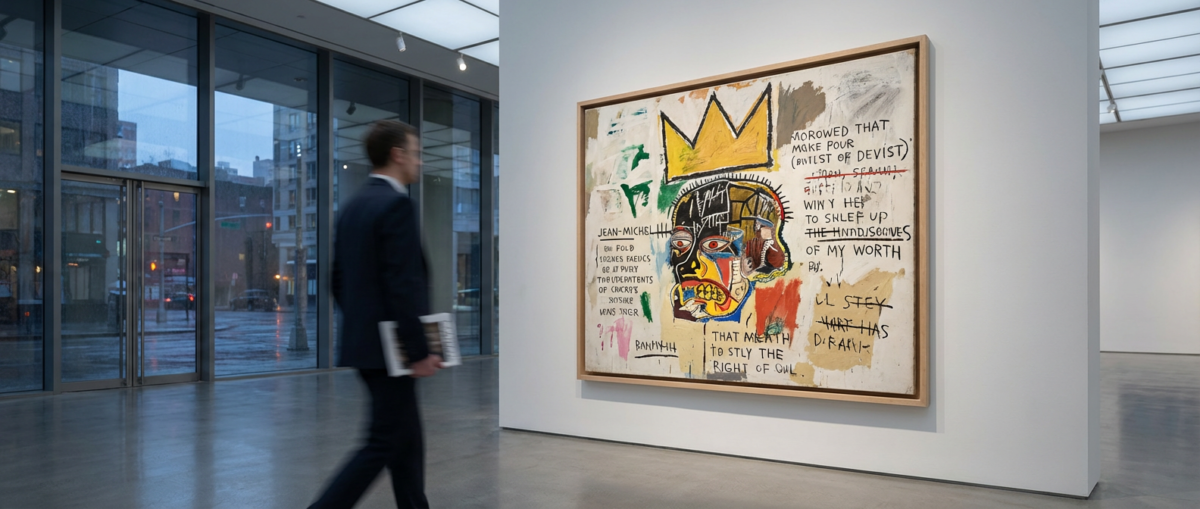
There is a particular species of institutional silence that speaks volumes. MoMA opened its first comprehensive solo retrospective of Jean-Michel Basquiat in late 2025, featuring over two hundred works spanning his brief career from 1980 to 1988. Standing before these paintings now, arranged across galleries with scholarly apparatus and curatorial intention, requires holding two truths at once: this exhibition is genuinely necessary, and its necessity points to a failure decades in the making. Basquiat died in 1988 at twenty-seven. MoMA waited nearly four decades before mounting a dedicated retrospective of this scale. The delay is part of the story.
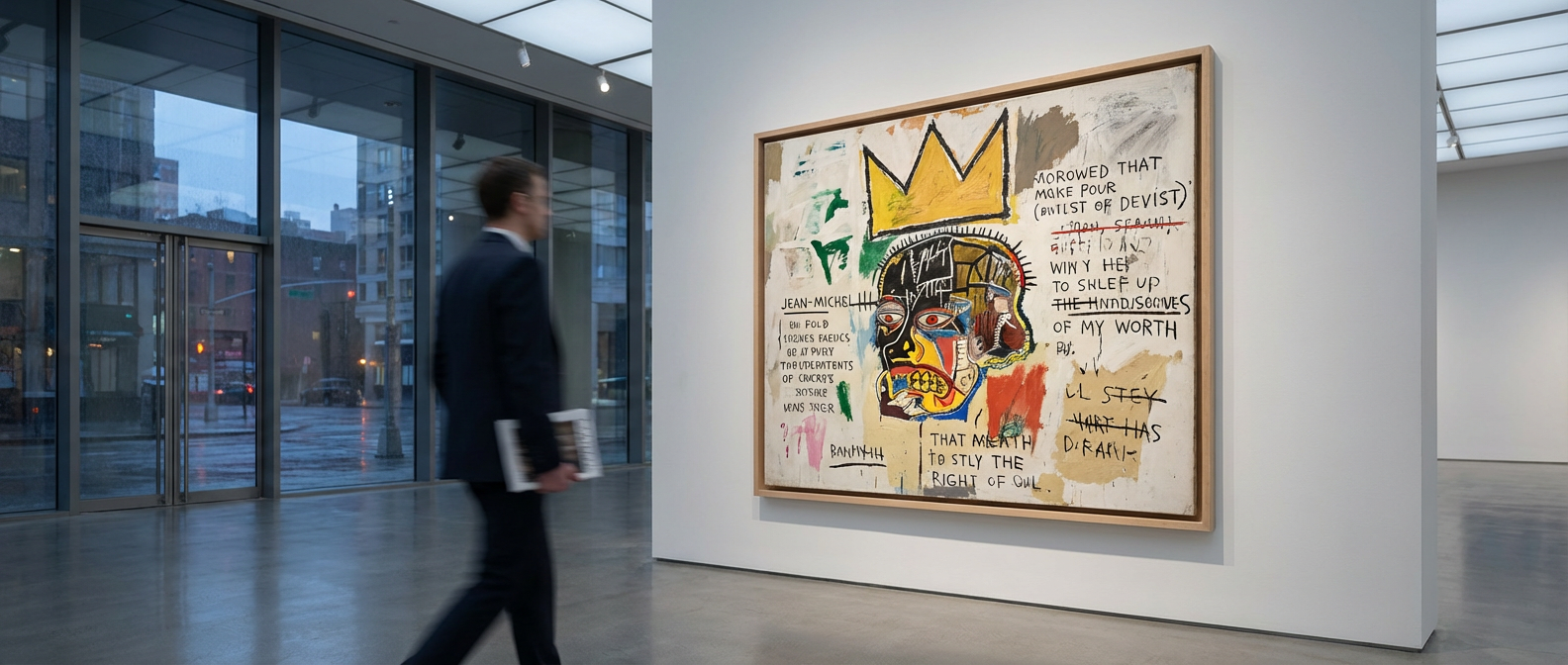
Think about what that timeline actually means. While his work sold for record-breaking prices at auction, while collectors and speculators transformed his paintings into financial instruments, the artist himself remained suspended in this strange category: commercially significant, institutionally homeless. This was not accidental. It is the particular trajectory reserved for certain artists, certain bodies, certain visions that the establishment eventually acknowledges while staying deeply ambivalent about the revolution they actually represent.
The Market Spoke First, Museums Followed
The economics of Basquiat’s vindication follow a peculiar logic. In 2017, one of his untitled works from 1982 sold at Sotheby’s for $110.5 million, a record for an American artist at auction at that moment. The art market had already decided his worth. Collectors understood his historical importance. Dealers built empires around his scarcity. Yet the same institutional guardians who manage our cultural memory moved with glacial slowness, as though waiting for something to be settled that never quite needed settling.
That inversion matters. Museums are supposed to be the authorities on artistic significance, the places where market value and historical meaning separate. Instead, MoMA followed the market’s lead, arriving at its own retrospective like a guest showing up after the party ended. There is something almost apologetic about that sequence. The retrospective catalog, published by MoMA Press and running to four hundred pages with newly commissioned essays from scholars including Kellie Jones, reads partly as institutional reckoning, partly as an effort to reclaim narrative authority through sheer scholarly apparatus.
The Structural Problem: One Artist Among Many Absent
Focusing only on Basquiat’s case, though, misses the larger architecture of institutional neglect. An Artnet Intelligence Report examining museum acquisitions between 2008 and 2023 found that Black artists represent only 1.2 percent of works acquired by major U.S. museum collections during that period. Let that number sit for a moment. One point two percent. In a country where Black artists have been central to virtually every major American art movement of the twentieth and twenty-first centuries, from abstraction to conceptualism to street art, they occupy a tiny fraction of museum acquisitions across a fifteen-year span that includes the rise of social media, unprecedented access to image archives, and sustained critical attention to questions of institutional diversity.
Basquiat’s retrospective, then, is something more complex than a single artist finally receiving his due. It is a visible acknowledgment of a structural problem that stays largely invisible in the everyday operations of most institutions. The exhibition becomes a kind of proof of concept: yes, institutions can mount ambitious retrospectives of Black artists; yes, these shows can draw crowds and generate scholarship and shift conversation. But that proof exists against a backdrop of continued exclusion elsewhere. One major retrospective does not undo four decades of acquired caution.
What the Exhibition Actually Reveals
Walking through the retrospective, arranged chronologically and thematically across multiple galleries, something unexpected happens. The familiar narratives about Basquiat start to dissolve. He emerges not as the tragic prodigy, not as the street art phenomenon turned gallery darling, not as the Black artist who “made it” despite the odds. He appears as a working artist engaged in rigorous formal experimentation, deeply conversant with art history, explicitly responding to particular moments and movements and predecessors. His paintings reference Cy Twombly and Picasso, grapple with questions of abstraction and representation, engage with color theory and compositional strategies. The work is not less powerful for being rooted in serious artistic genealogy. It is more powerful.
You can see in the progression from his earlier works through 1988 an artist becoming more conceptually ambitious, more willing to push toward abstraction, more interested in what paint itself could do beyond representation. This is not the arc of a phenomenon burning out. It is the trajectory of an artist just beginning to fully inhabit his own vision. His early death becomes newly painful when you understand what directions he might have pursued.
Expensive Apology or Genuine Reckoning?
Any major museum retrospective of a historically marginalized artist raises the same question: is this genuine institutional reckoning or expensive apology? There is no clean answer. Any exhibition exists within a particular moment, within a particular institution’s constraints and politics and priorities. MoMA’s Basquiat show is real scholarship, genuine curatorial work, a meaningful contribution to how we understand this artist. It is also a PR move, a demonstration of institutional progressivism, a way of saying we acknowledge the problem without restructuring the systems that created it.
The more generous reading is that these things are not mutually exclusive. Institutions change incrementally. Retrospectives matter. They shape what gets taught in classrooms, what gets preserved in cultural memory, what young artists see as possible. Visit MoMA’s official Basquiat exhibition page to understand the scope of what this institution has chosen to commit its resources toward. And look at that commitment against the statistical reality: the Artnet Intelligence Report on museum diversity shows how far institutions still need to travel.
The most honest response to this retrospective is not to settle into either celebration or dismissal. This is necessary work. It is also incomplete work. It matters. And it should have happened decades ago. You might find yourself looking at a Basquiat painting and seeing not a tragic young genius but a careful artist thinking through color and form. You might also find yourself wondering what voices remain unheard, what archives remain uncurated, what artists are still waiting for their institutional arrival.