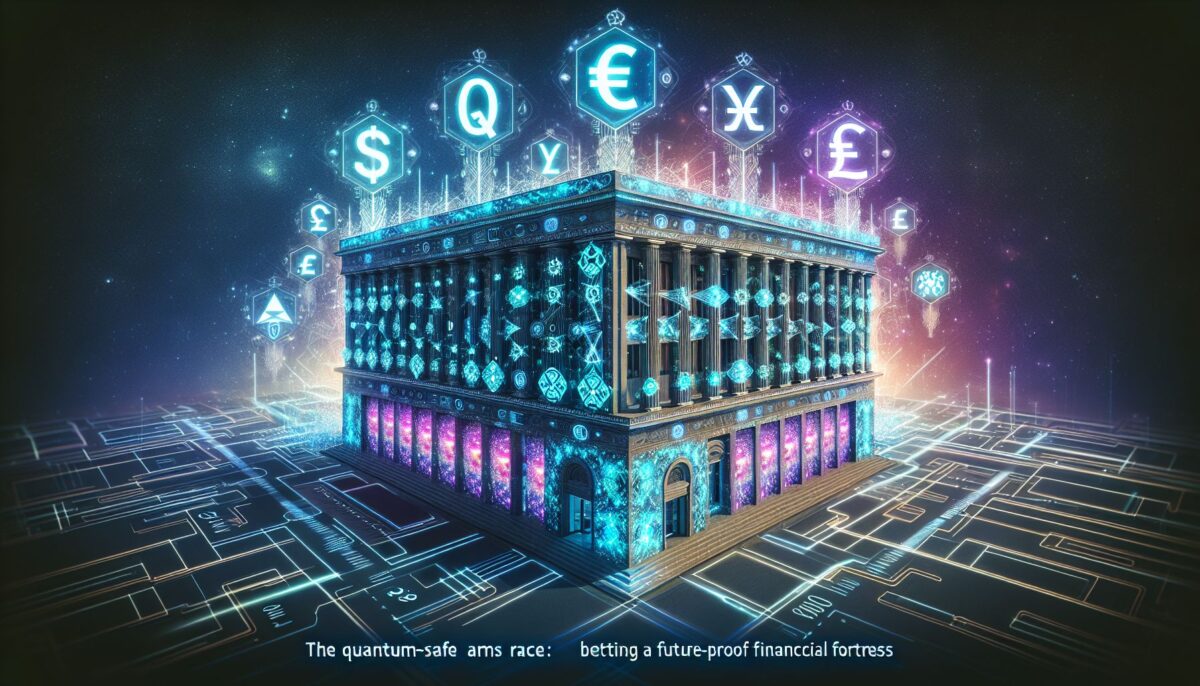
Let’s play a little thought experiment. Imagine waking up one fine morning to a dystopian headline: “Quantum Computer Cracks Bitcoin Encryption.” You might be sipping your morning brew, but let me assure you, the financial world just spilled its collective coffee. In a heartbeat, the blockchain, along with most encryption protocols we rely on, becomes as secure as a paper plane in a hurricane. Welcome to the weird and wonderful world of quantum computing, a frontier so cutting edge, it needs chainmail gloves and a sidekick robot dog.
The Quantum Dawn: A Fuzzy Future
Now, you might wonder, how far are we from this quantum dawn? Google, IBM, and that mysterious quantum outfit funded by dark Silicon Valley money are racing towards it like fintech nerds storming a Web3 hackathon. Some skeptics argue we’re still years away from practical quantum supremacy. But here’s the thing about exponential tech: it’s like being on a rollercoaster without a seatbelt. You better be ready for a sudden drop.
Policy Puzzles and Regulatory Rubik’s Cubes
You know what’s even more complex than quantum algorithms? Yup, you guessed it: global financial regulation. As we flirt with quantum tech, regulators are juggling the dual challenge of encouraging innovation while safeguarding the public’s digital purse. From cryptographic agility mandates to quantum-resistant standards, policymakers are scrambling like sugar-high squirrels. They want to make sure that when the qubits hit the fan, financial systems won’t crumble under their own outdated encryption schemes.
The Geopolitical Jigsaw
Speaking of regulation, let’s add geopolitics into our mix. Nations are treating quantum tech like it’s the new nuclear arms race, only this time it’s a race for intellectual forts rather than physical force. The U.S., China, and the EU are pouring billions into quantum research, intent on leading the quantum charge. Let’s be honest, they want to avoid getting caught with their pants down in codebreaker land. This geopolitical influence peddling inevitably shapes how governments view quantum-safe banking. It’s about who can buzz the next big thing first and control the narrative, not just the ledger.
Market Mad Science: Investors and Engineers at Play
A quantum-safe banking future isn’t just a task for regulators and governments. It’s a playground for the brilliant weirdos that are fintech engineers and investors. Innovations in post-quantum cryptographic methods are unlocking investment doors faster than you can say “zero-knowledge proofs.” We’re talking about the rise of quantum venture funds, dedicated to backing startups with their eyes set firmly on outsmarting even the grandest quantum computers. If you’re a builder and aren’t investigating quantum resistance, you might as well be pouring money into a pineapple pizza subscription service. It’s that fringe and that essential.
The Embedded Quantum Clause
While we geek out about quantum computing and its ramifications on digital finance, let’s not forget the embedded fintech revolution unfolding in parallel. As finance becomes as ubiquitous as wifi, the need for quantum safety will permeate every corner of our interconnected economy. From microtransactions conducted by IoT devices to grandiose cross-border payments, embedding quantum-safe protocols will be as fundamental as embedding spell-check in your text editor. Don’t sleep on the embedded wave as just another bot doing your crypto taxes at 3 AM.
Quantum Harmony: A Question of Balance
In the maelstrom that is quantum tech and its impact on finance, the challenge will be to strike a balance between security and usability, between investment and innovation. This isn’t just about hypersecure protocols or absurd computational power. It’s about creating a financial infrastructure that withstands the test of time and hackers with a penchant for Schrodinger equations.
The Takeaway: Quantum Safe and Sound?
So what’s next? As we tread the quantum tightrope, those poised to future-proof their stacks with sound cryptographic practices today might just be an upgrade away from navigating tomorrow’s qubit chaos. It’s both an existential and an exponential challenge, but hey, aren’t those the best kinds?
Provocative Question
Here’s something to ponder, dear builders: Are we doing enough to chase the quantum dawn, or will the first to break the blockchain be a shadowy cabal of hoodie-wearing quantum cowboys with cat memes for logos? Let the comments section be your sandbox.