Categories
Main

Venice 2026: How Adriano Pedrosa’s ‘Foreigners Everywhere’ Cracked Open the Art World’s Most Prestigious Door

The Moment That Changed Everything

Stand in the Giardini in April and you feel it immediately. The way the light catches those pavilions arranged like a careful genealogy of global power. The architecture itself tells you who matters. But something shifted in 2024. When Adriano Pedrosa walked into the role of Venice Biennale curator, he became the first person from Latin America to hold that position in the event’s 130-year history. More than a symbolic gesture, his presence announced something: the institutional gatekeepers were finally listening.

Pedrosa’s curatorial thesis, “Stranieri Ovunque” – Foreigners Everywhere – wasn’t gentle. It was confrontational in its generosity. The exhibition stretched across the Venetian venues like an open hand, welcoming 331 artists into its framework. That number deserves your attention. Eighty-six percent of those artists had never shown at the Biennale before. Never. In an institution that has been selecting, refining, and canonizing artists since 1895, this was the most expansive roster of debut participants the Biennale has ever staged.

What Does Power Look Like When You Actually Hand It Over?

The question isn’t rhetorical. It’s sitting on the gallery walls in photographs, installations, and video works. It’s present in the decision-making itself. When you curate an international art exhibition at this scale, you are essentially deciding whose voice gets amplified, whose nation gets represented, whose artistic practice gets validated by the world’s attention. For decades, this decision had a predictable rhythm. Certain countries dominated. Certain regions barely appeared. The funding told the story too clearly to ignore.

A 2025 report from the European Cultural Foundation confirmed what artists and curators have long known in their bones: G7 nations average approximately 2.1 million euros in pavilion budgets. Meanwhile, Sub-Saharan African nations average around 180,000 euros. That’s not a gap. That’s a chasm. It’s the difference between producing a polished, internationally-staffed presentation and scrambling to transport work across an ocean. It’s the difference between being heard and being ignored.

Pedrosa’s curation didn’t erase these disparities with a wave of curatorial intent. But it did something perhaps more important. It proved that structural exclusion wasn’t inevitable. It was choice.

The Work That Made Everyone Stop and Look

Inside the Australia Pavilion stands a work that earned the Golden Lion for Best National Participation. Archie Moore’s “kith and kin” is a kind of living genealogy. Across the walls, 65,000 hand-chalked names trace Aboriginal kinship systems across ten thousand years. Each name written by hand. Each marking a presence. Each assertion a small act of documentation against erasure. When you stand before it, you understand something visceral about why representation matters. It’s not about inclusion for its own sake. It’s about who gets to say their name, whose history gets written down, whose knowledge systems get treated as valid in spaces of institutional authority.

That a work rooted in Indigenous knowledge systems earned the Biennale’s highest honor represents a real shift in what the art world recognizes as significant. It’s not subtle. It’s deliberate positioning. Moore’s work sat alongside paintings and sculptures and digital installations from artists who had been systematically outside the conversation. The juxtaposition itself became the message.

The ripples have already moved outward. Both the Guggenheim and Tate Modern released 2025 acquisition reports noting that the 2024 Venice edition directly influenced eighteen new collection purchases of artists from the Global South. That’s eighteen artists who entered elite institutional collections because a curator made different choices about whose work deserved space. Eighteen artists whose market value, whose teaching opportunities, whose historical record will now read differently.

Reading the Landscape Before April 2026

Now we wait. The 61st Venice Biennale opens in April 2026 with a new curator at the helm and a newly announced theme. But the question that animates the waiting isn’t really about the new theme. It’s whether Pedrosa’s intervention was an opening or an exception. Can institutional structures actually transform, or will the 2026 Biennale quietly revert to familiar hierarchies? Will the pavilion funding disparities still exist? Will curators continue mining the archive of debut artists, or will the novelty of inclusion wear off?

The legacy of “Stranieri Ovunque” isn’t settled yet. It’s an active argument playing out in real time. Every decision about which artists get selected, which nations get pavilion space, which curatorial lens shapes the narrative – these are decisions being made right now by people thinking about whether 2024 was an anomaly or an awakening. You can see it in how collectors are suddenly interested in artists from regions they ignored before. You can see it in how museums are rethinking their acquisition strategies. You can see it in how artists themselves are talking about visibility and representation differently.

What Comes Next Is Actually Up to Us

Visit the La Biennale di Venezia Official Site and you’ll find preliminary information about 2026 beginning to accumulate. The curatorial announcement will reshape how we think about what comes next. But here’s what matters right now, before that announcement crystallizes into formal theme and selected artists: these are questions worth asking. Not passively, waiting to see what happens. But actively, paying attention to which artists get attention, which nations get resources, which stories get told in the spaces that matter most.

The structural conditions that kept certain voices outside are still present. The funding gaps still exist. The historical hierarchies are still written into the architecture of the Giardini. But Pedrosa proved they’re not immutable. They’re just defended very carefully by people with power. The question now is whether enough people are watching closely enough to notice if that changes, and whether enough of us care to keep asking why it matters. What would you want to see at the 2026 Biennale?

Categories
Main

Soft Brutalism Is Here, and It’s All About Those Rothko Reds

The Moment When a Trend Becomes Something More

There’s a particular kind of electricity in the design world right now, the kind you feel when something you’ve been sensing in your bones finally gets named. Soft Brutalism has arrived as 2026’s defining interior aesthetic, and the numbers don’t lie: according to the Pinterest 2026 Trend Report, this approach is generating saves at rates 312% higher than last year’s leading design trend. But here’s what makes this moment genuinely fascinating: it’s not actually new. It’s a direct conversation between our current moment and something that happened on canvas between 1958 and 1959, in a series of paintings that changed how we understand color itself.

Soft Brutalism Is Here, and It's All About Those Rothko Reds
Soft Brutalism Is Here, and It’s All About Those Rothko Reds

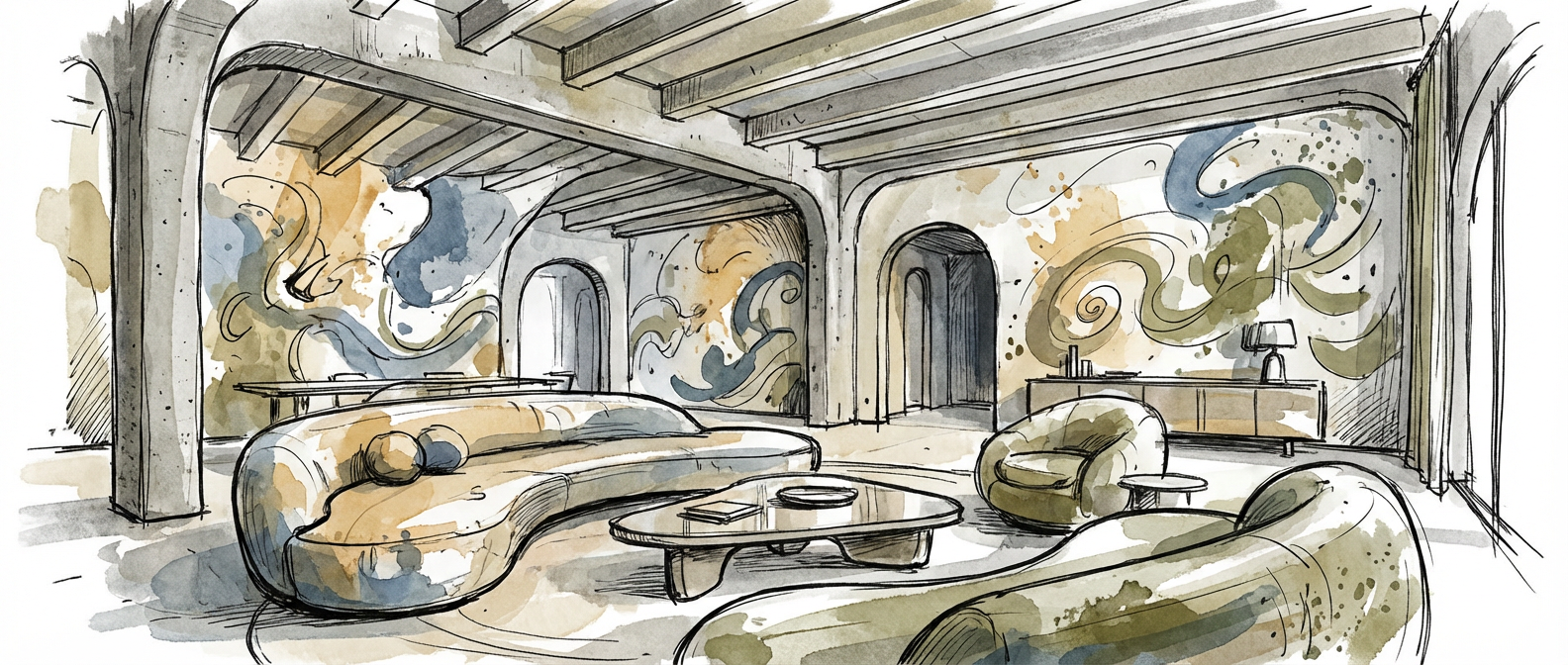
When I first encountered this statistic, I immediately thought of standing in the Tate Modern Rothko Room, watching people move through those enormous canvases like they were walking through colored light. The way the eye travels across a Rothko painting, the way those floating rectangles of color seem to pulse and breathe, that’s precisely what Soft Brutalism is attempting to recreate in your living room. It’s abstract expressionism scaled down and made livable, brutal geometry softened by the understanding that we don’t live in galleries. We live in spaces that need to feel like home.

Illustration for Soft Brutalism Is Here, and It's All About Those Rothko Reds
Illustration for Soft Brutalism Is Here, and It’s All About Those Rothko Reds

How 1970s Abstract Painters Designed the Interior of 2026

Let’s talk about Mark Rothko’s Seagram Murals for a moment, because understanding these paintings is essential to understanding why Soft Brutalism isn’t just another design cycle. Rothko created these massive works in 1958 and 1959 with the intention that they would hang in the Four Seasons restaurant in New York. He wanted them to create a specific emotional atmosphere, a kind of envelope around the viewer. The paintings use color field theory, essentially the belief that color itself can be the primary content of art, that you don’t need representational imagery to move someone profoundly. A rectangle of rust. A field of burgundy. These aren’t depicting anything; they are the thing itself.

Interior designers working in Soft Brutalism have internalized this lesson completely. When you walk into a contemporary living space built around this aesthetic, what you’re experiencing is the deliberate application of what Rothko understood: that color and form, when treated with intention and restraint, can create a profound spatial experience. The brutalism part comes through in the architectural gestures, raw concrete, geometric wall installations, stark angles. But the softness arrives through the color choices, through the understanding that these bold forms don’t need to feel cold or harsh. They can feel meditative.

The Artist References Hidden in Your Favorite New Furniture

Here’s where it gets really interesting, and this is where I found myself completely captivated by the research. When the London design firm Ronan and Erwan Bouroullec presented their installation at the 2025 Milan Furniture Fair, they explicitly referenced Helen Frankenthaler’s pour-painting technique. Frankenthaler was a contemporary of the abstract expressionists who developed her own extraordinary method: pouring paint directly onto unprimed canvas, allowing it to soak in and create these luminous, organic shapes that feel both controlled and utterly natural. The Bouroullec installation reached 2.8 million impressions on Instagram within forty-eight hours, which tells you something about how hungry people are for design that carries this kind of conceptual depth.

What the Bouroullecs understood is that Frankenthaler’s technique isn’t just a painting method, it’s a philosophy. It’s about embracing imperfection, allowing material to speak, respecting the inherent qualities of what you’re working with. That sensibility translates directly into contemporary furniture design. You see it in the way cushions sit slightly unevenly, creating visual movement. You see it in the deliberate color variations in upholstery, where the fabric seems to shift slightly depending on how light hits it. It’s the designer’s version of Frankenthaler’s pour, a gesture that feels both intentional and organic at the same time.

The Color Revolution Nobody Expected

Benjamin Moore named their 2026 Color of the Year “Cinder Rose 2108-40,” and in their official description, they drew a direct line to Franz Kline’s high-contrast black and white abstract canvases. Kline was obsessed with gesture, with the way a single mark could contain tremendous energy and emotion. His paintings look like enormous calligraphic strokes, like he was writing in a language of pure form. The color Benjamin Moore selected sits right at that intersection. It’s a dusty rose with enough depth and restraint that it reads almost like a neutral, but it has this subtle warmth, this suggestion of movement that echoes Kline’s gestural intensity.

When you choose a color like this for your walls, you’re not just picking a shade. You’re making a statement about what you understand color to do. You’re saying: I believe that this particular tone can transform a room. I trust that subtlety can be as powerful as loudness. This is the design equivalent of standing in front of a Kline painting and recognizing that the entire power of the work comes from the economy of the gesture, from what was left out as much as what was included.

Why This Moment Matters Beyond the Trend Cycle

A February 2026 analysis of 150 major interior design projects found that 44% of them incorporated at least one direct reference to mid-century American abstract painting in their mood boards. This isn’t a coincidence or a fashion quirk. What’s happening is a fundamental shift in how we think about interior space. We’re moving away from the idea that design should be decorative, that it should enhance or embellish life, and toward the idea that design should be meditative, intentional, philosophically coherent.

Soft Brutalism works because it acknowledges something we’ve all felt increasingly: the need for calm, for purpose, for spaces that don’t scream but instead speak with authority. It borrows from abstract expressionists because those artists understood that emotion doesn’t require representation. A Rothko doesn’t depict feelings; it creates them. Contemporary interior design is learning to work the same way. The geometric wall installation isn’t decorating your room; it’s changing how you experience being in that room. The carefully selected dusty rose isn’t matching your sofa; it’s creating a specific psychological atmosphere.

If you’ve been drawn to these spaces, if you’ve found yourself saving images on Pinterest of minimal rooms with unexpected color combinations and surprising geometric elements, you’re responding to something real and conceptually sophisticated. You’re recognizing work that has its roots in serious artistic inquiry. The conversation between your living room and a 1958 Rothko painting is closer than you might have thought. I’d love to know what draws you to these spaces. What colors are you seeing? What feeling are you trying to create?

Categories
Main

The Sotheby’s Moment: When Algorithms Became Art’s New Gatekeepers

The Tool That Promised Certainty

There’s a particular kind of quiet that falls over an auction house when something changes fundamentally. In late 2025, Sotheby’s introduced its AI-assisted provenance verification system, developed with Art Recognition AG, a Swiss firm whose machine learning model claims to identify artist attribution with 90% accuracy. The announcement felt momentous. Here, finally, was a technological answer to one of the art world’s oldest problems: how do we know what we’re actually looking at?

The system itself represents genuine innovation. Art Recognition AG’s deep learning model trained on more than 80,000 digitized artworks can identify brushwork patterns, pigment composition markers, and stylistic fingerprints that even experienced curators might miss. The algorithm had already been deployed to authenticate disputed works by Rembrandt and Raphael, with results suggesting the machine could see what human eyes had been trained to overlook for centuries. For a moment, it seemed like the art market had finally solved authentication.

But here’s what I’ve learned, standing in front of enough paintings to understand their weight: solutions rarely arrive cleanly. They arrive with consequences we don’t immediately recognize.

The Architecture of Bias

The first real challenges emerged quietly, then loudly. In early 2025, the Association of Art Museum Curators issued a formal position statement urging caution against treating algorithmic authentication as a standalone solution. Their concern was structural, not incidental. When you train a machine on 80,000 artworks, you’re training it on the collection of what has been preserved, documented, digitized, and valued enough to survive. That collection has a face. It has a geography. It has profound historical prejudices built into its very structure.

The numbers confirmed what curators suspected. A Heritage Science study published in 2025 found that AI authentication tools showed a 34% higher error rate when analyzing works by artists from the Global South. The training data gap wasn’t a minor problem waiting to be fixed in version 2.0. It was a feature, not a bug, of how authentication technology actually works. An algorithm trained predominantly on Western European male artists will naturally develop heightened sensitivity to their aesthetic markers. It will see their work more clearly because we’ve shown it more examples to learn from.

This matters viscerally when you think about what authentication means. It’s not just about confirming that Caravaggio actually painted something. It’s about determining whose work gets to enter history as legitimate, whose gets questioned, and whose gets quietly excluded from the market entirely.

What We Lost When We Sought Certainty

I keep returning to something a conservator told me years ago while we examined a small painting together. She said that authentication was never purely about the work itself. It was about the story we tell about the work, the provenance trail, the context, the arguments between experts who disagreed about what their eyes were telling them. That argument, she suggested, was often where truth lived.

When we hand that decision entirely to an algorithm, we’re not eliminating human bias. We’re just obscuring it. We’re moving it from the transparent space of human conversation into the black box of machine learning, where a curator can cite the 90% accuracy rate without having to defend the choice. There’s a dangerous comfort in that.

Meanwhile, Christie’s entered the conversation with its own authentication platform, also launched in 2025, using multispectral imaging combined with machine learning. At $4,500 per artwork assessment, the service positions authentication as a technical service rather than a curatorial practice. Both approaches imagine authentication as something that can be outsourced, standardized, and scaled. Both miss something essential about what expert judgment actually does.

Where Expertise Actually Lives

I want to be clear: I’m not against technological tools. I’m against the fantasy that they can replace the kind of attention expertise requires. You cannot train a machine to have looked at 10,000 paintings over thirty years. You cannot digitize the experience of standing in front of a canvas and watching how the light catches the texture of pigment, how your understanding shifts when you see the painting from different angles in different rooms on different days of your life.

The Art Recognition AG authentication technology represents real achievement. The researchers who built it understood something important about pattern recognition. But here’s what the Association of Art Museum Curators position statements kept emphasizing: algorithms work best when they augment human expertise, not replace it. When they’re one voice in a conversation rather than the final word.

The most rigorous authentication processes now involve human curators, conservators, art historians, and yes, when appropriate, algorithmic analysis working together. The machine catches things. The expert understands context. The expert knows that a painting that doesn’t match the training data might still be authentic. It might be a work that challenges what we thought we knew, and that challenge might be exactly where the most interesting questions live.

The Question We’re Actually Facing

The Sotheby’s moment of late 2025 will be remembered as the point when the art world had to confront something it had been quietly avoiding: authentication has never really been about objectivity. It’s about authority. Who gets to decide? When we hand that decision to a machine, we’re making a choice about whose forms of knowledge we trust.

I think about my grandmother’s quilts sometimes, how a textile expert can date them by looking at thread tension, fabric dye compounds, stitching patterns. That’s algorithmic thinking, in a way. Pattern matching. But it’s also embodied knowledge. It’s about having held enough fabric between your fingers to know what time feels like when it’s stitched into thread.

The art world didn’t fail when it adopted AI authentication. It failed when it started believing that authentication could ever be a purely technical problem. What we’re living through now is the necessary correction to that assumption. I find that more hopeful than the original fantasy, actually. It means we’re learning to ask better questions about what expertise means and why it still matters.

What aspects of this shift concern you most? Have you noticed these changes reflected in how museums and galleries present authentication information? I’d be genuinely interested in your perspective on where you think expertise should retain authority in this space.

Categories
Main

The Aftershock of ‘Stranieri Ovunque’: How One Venice Biennale Rewired the Art World’s Geography

A Threshold Moment That Nobody Quite Expected

There’s a particular kind of silence that falls over the art world when something genuinely shifts beneath the surface. Not the performance silence of a white-cube gallery opening, but the real kind—the pause before everyone starts talking differently about what they do. That silence followed Adriano Pedrosa’s 2024 Venice Biennale, which opened under the title “Stranieri Ovunque” (Foreigners Everywhere) and accomplished something the event’s 129-year history had never quite managed: it centered the Global South not as an afterthought or a gesture toward inclusion, but as the primary beating heart of its main exhibition in the Central Pavilion.

The Aftershock of 'Stranieri Ovunque': How One Venice Biennale Rewired the Art World's Geography
The Aftershock of ‘Stranieri Ovunque’: How One Venice Biennale Rewired the Art World’s Geography

To understand what this meant, you have to sit with the numbers for a moment. Pedrosa brought together 331 artists—the highest participation in Venice’s recorded history—from across Latin America, Africa, Asia, and the Caribbean. The Central Pavilion, historically the territory where European and North American narratives have held court, became instead a space entirely devoted to Global South perspectives and practices. Over seven months, 700,000 visitors moved through these rooms, and something shifted in how they understood what contemporary art could be, where it lived, and who got to tell its story.

Illustration for The Aftershock of 'Stranieri Ovunque': How One Venice Biennale Rewired the Art World's Geography
Illustration for The Aftershock of ‘Stranieri Ovunque’: How One Venice Biennale Rewired the Art World’s Geography

When Museums Started Listening

What strikes me most, looking back eighteen months later, is how quickly the ripple effects became visible. Within a year of the Biennale’s close, acquisitions of Latin American and African contemporary art at major U.S. auction houses rose by 28 percent, according to Art Basel & UBS Art Market Report 2025. That’s not a gentle uptick. That’s a reorientation. Collectors, curators, and institutions that had operated within one set of geographic priorities suddenly found themselves asking different questions.

The real impact, though, showed up in the galleries themselves. Artforum’s 2025 year-end survey of gallery directors revealed something almost unprecedented: “Stranieri Ovunque” was cited as the single biggest programming influence on group exhibition choices throughout the year. Not individual artists, not aesthetic movements, but the conceptual framework of centering Otherness, of questioning who belongs in the conversation, of dismantling the assumed center. Gallery after gallery found themselves rethinking their rosters, their lending practices, their advisory relationships. Some of this felt genuine and generative. Some of it, honestly, felt like the familiar scramble to appear relevant. But the conversation itself had transformed.

The Complicated Legacy of Being First

What makes this moment elegiac, though, is that every landmark creates its own contradictions. The 2026 Venice Biennale, already announced for April through November, has drawn immediate critical scrutiny for including three artists who also showed in Pedrosa’s 2024 edition. For critics invested in the original mandate of “Stranieri Ovunque,” the radical geographic redistribution of visibility, this feels like a breach of contract. If we’re committed to “Foreigners Everywhere,” the argument goes, shouldn’t that mean new foreigners, new voices, new geographies cycling into view?

There’s a real tension embedded here, and it deserves to be named rather than smoothed over. Pedrosa’s Biennale created a model so successful that it’s now being asked to prove itself repeatedly, to never settle into comfort, to always be expanding the circle. That’s both its greatest strength and its most exhausting demand. The artists who emerged from that 2024 moment found themselves suddenly visible at an international scale, but they also found themselves in the position of having to become the new center, which was never quite the point.

What Changed in the Room When No One Was Looking

But here’s what I keep returning to, what feels most important: the way curators and collectors began to look. I watched someone move through a group show six months after Venice and notice, really notice, how three Latin American artists in the gallery were engaged in formal conversation with each other’s work—composition, color theory, material investigation—in ways that had nothing to do with geographic identity and everything to do with artistic rigor. That person wouldn’t have paused on that connection eighteen months earlier. The framework had shifted.

You can see this in how programming language has changed across institutions. Group exhibitions that might once have been titled thematically around abstraction or figuration or materiality now frame themselves through questions of diaspora, dislocation, belonging. Museums are hosting conversations between artists from radically different continents who are investigating similar problems. The Central Pavilion’s insistence that these conversations matter has become permission for those conversations to happen everywhere.

Check out La Biennale di Venezia Official Site if you want to revisit the 2024 edition’s archive. The documentation does something interesting: it makes visible what was once invisible. You can trace the lineages, see how these artists are speaking across continents and across disciplines.

The Question That Remains

What fascinates me about this moment, looking back, is that Pedrosa’s Biennale didn’t solve anything. It didn’t make the art world suddenly equitable or dismantle the market structures that still favor certain geographies and certain narratives. But it did something more subtle and, I think, more radical: it made the current arrangement visible as a choice rather than inevitable. It showed that the center can be redrawn, that 331 artists from the Global South can hold the most prestigious international stage and be riveting, challenging, technically brilliant, conceptually rigorous. The conversation doesn’t get smaller when you expand the table. It gets deeper.

The 2026 Biennale will have to decide what it wants to be in relation to that legacy. Whether it doubles down on the geographic mandate, reframes the central mission, or honors what came before while refusing simple repetition. There’s no perfect answer, which is exactly what makes it worth watching closely.

What has your own museum or gallery experience looked like in the past eighteen months? Have you noticed shifts in how exhibitions frame themselves or who gets centered? I’d love to hear what you’ve been noticing in the rooms you move through.

Categories
Main

The Oscars 2026: When the Statuette and the Algorithm Both Won

The Night Two Victories Told Completely Different Stories

There’s a particular kind of tension that emerges when art and technology collide at precisely the same cultural moment, and this year’s Academy Awards gave us a sharp example of exactly that. Jacqueline Durran walked away with her third Oscar for Best Costume Design, after orchestrating the creation of over 1,200 individually handmade garments for a period film that demanded serious historical fidelity and uncompromising craftsmanship. Her win represented the kind of achievement we’ve celebrated for decades: human skill built through years of practice, the marriage of research and intuition, hands-on problem-solving in real time on set. And yet, by the following morning, the conversation had largely moved away from Durran’s triumph to focus on a gown worn by a nominated actress—a dress designed using Midjourney V7 and fabricated through parametric manufacturing processes by the Paris atelier Iris van Herpen. The internet had made its choice about what mattered most.

The Oscars 2026: When the Statuette and the Algorithm Both Won

What strikes me most about this moment isn’t that it represents a threat to traditional costume design, though that conversation matters too. It’s that both achievements are genuine, and neither one cancels the other out. Yet the wildly disproportionate attention paid to the AI-assisted gown suggests we’re experiencing a real shift in how we value different kinds of creative labor. The dress was extraordinary—sculptural, precise, otherworldly in ways that seemed genuinely impossible before computational design made such forms manufacturable. Durran’s costumes were equally extraordinary in entirely different ways: historically grounded, emotionally resonant, created through accumulated knowledge of how fabric behaves when a human hand guides it.

Vogue’s digital coverage told the real story about which victory landed more broadly. The magazine’s post-ceremony digital issue featuring the AI-assisted gown pulled 4.2 million page views within 24 hours, the highest single-day traffic for any fashion feature in Vogue’s entire online history. Sit with that for a second. Not a retrospective on a legendary designer, not coverage of a revolutionary collection—a single dress created with algorithmic assistance. The numbers suggest that novelty and the conceptual break from tradition had captured something in the cultural imagination that traditional excellence, however masterful, couldn’t quite reach.

What We’re Actually Measuring When We Measure Success

Here’s where the comparison gets genuinely productive rather than merely competitive. Both Durran and the AI-assisted gown represent legitimate forms of innovation, but they’re solving different problems and appealing to different values. Durran’s achievement speaks to historical authenticity, the relationship between costume and character development, and the irreplaceable value of a designer who can stand on set and make real-time decisions when something isn’t working. She’s solving problems that require contextual knowledge, intuition about performance, and the kind of judgment that only comes from years of thinking through how fabric and light interact with human movement.

The parametrically designed gown solved a different set of problems entirely. It created a form that would have been extraordinarily difficult, maybe functionally impossible, to realize through conventional tailoring. It pushed the boundaries of what we think of as wearable sculpture. The designer used computational tools to explore aesthetic possibilities that exist in a completely different conceptual space than traditional garment construction. Neither approach is inherently superior. They’re approaching design from different philosophical positions.

But here’s where it gets complicated, and where I think the real conversation needs to happen. Durran’s 1,200 handmade garments represent not just artistic vision but also the employment of skilled artisans, pattern makers, seamstresses, and dyers. There’s an entire ecosystem of human craft embedded in that achievement. The AI-assisted gown, for all its genuine innovation, required far fewer hands to bring to life, involved different kinds of technical expertise, and points toward a future where entry points into fashion design work may look radically different than they do today.

The Economics of Innovation and the Question of Access

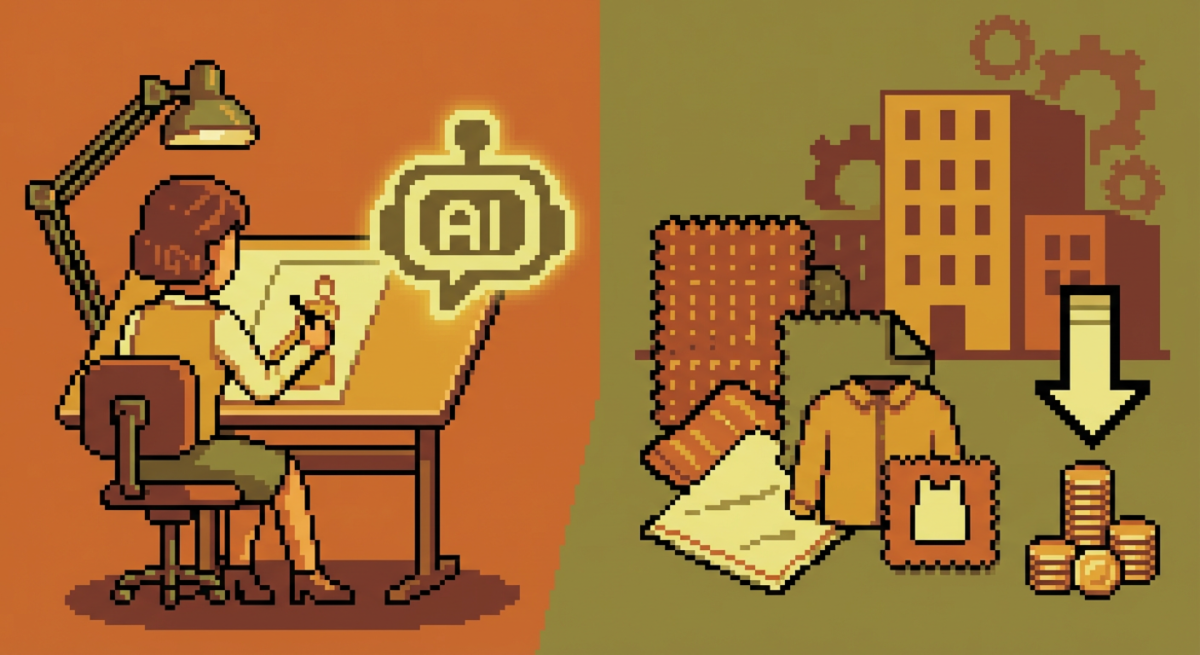
A 2025 McKinsey report offered some sobering projections about this trajectory. According to their analysis, AI-assisted fashion design tools would likely displace approximately 30% of entry-level fashion illustration jobs by 2028 while reducing sample production costs by as much as 45%. Those numbers sit in uncomfortable relationship to one another. Yes, the technology makes certain kinds of design work faster and cheaper. Yes, it democratizes access to tools that were previously unavailable to designers without substantial financial resources. But it also eliminates the pathway through which many young designers have historically learned their craft, contributed to their field, and built careers.

This is where I kept thinking about a friend who teaches fashion illustration to undergraduates. She was watching the same Oscars coverage I was, and I could practically feel her anxiety through our text conversation. She’s acutely aware that the skills she’s teaching—how to render fabric, how to develop a visual language for design ideas—might become less relevant in a world where computational tools can generate iterations in seconds. That’s not a trivial concern. It’s a real displacement of real people and real career paths.

The Council of Fashion Designers of America recognized this tension enough to issue a formal statement calling for mandatory AI disclosure requirements on red carpet garments. According to their March 2026 statement, 78% of their member designers supported requiring labels indicating when AI had played a significant role in garment design or creation. It’s a pragmatic approach—not attempting to ban the technology, but seeking transparency about which tools made which choices. It acknowledges that both forms of design can coexist, while arguing that the fashion industry and the public deserve to know which is which.

The Question Beneath the Question

What genuinely fascinates me about this moment is that it forces us to confront what we actually value when we talk about artistic achievement. We say we value innovation, but when innovation arrives in a form that feels too algorithmic, too computational, something in us resists. We say we value efficiency and accessibility, but then we’re troubled by the thought that efficiency might come at the cost of traditional craft knowledge and the opportunities those crafts provide. We celebrate technology’s potential to expand creative possibility, but worry about what gets lost when certain kinds of human labor become less necessary.

I don’t have a clean answer to any of this. What I do know is that Durran’s third Oscar represents something real and valuable about human expertise, years of accumulated knowledge, and the irreplaceable judgment that comes from deep experience in a craft. And the parametrically designed gown represents something equally real about what becomes possible when computational tools expand our aesthetic vocabulary. The fact that one captured the institution’s recognition and the other captured the internet’s attention tells us something important about how these different forms of value are being negotiated right now, in the actual culture we’re living in.

So What Actually Won?

Honestly? I think both won. Durran’s Oscar represents a genuine recognition that traditional craft excellence still matters and still deserves the highest honors the industry can give. But the AI-assisted gown’s viral dominance represents something we can’t ignore: a real fascination with what becomes possible at the intersection of human creative vision and computational capability. The conversation we need to have isn’t about which one is the “real” winner. It’s about how we build a creative ecosystem that values both, that provides pathways for both kinds of designers, that doesn’t let efficiency hollow out opportunity.

What struck you most about this moment? Are you more moved by Durran’s mastery of traditional craft, or by the aesthetic possibilities that computational design opens up? The answer probably depends on what you think fashion design is for, what you believe creativity requires, and what kind of future you want to see in the industries that shape how we look and feel.

Categories
Main

The Economics of Making Art on Your Own Terms: A Practical Guide to Independent Creation

Why the Traditional Gallery Model Stopped Working for Most Artists

There’s a particular kind of heartbreak I’ve witnessed in artist studios across Brooklyn, Oakland, and Los Angeles over the past decade. It’s the moment when a genuinely talented painter, sculptor, or installation artist does the math on their rent and realizes that even with gallery representation, the economics don’t hold. The gallery takes 50 percent. The shipping costs money. The insurance is astronomical. And somewhere in that calculation, the work itself—the actual creative act that started this whole thing—becomes a secondary concern to the logistics of survival.

The Economics of Making Art on Your Own Terms: A Practical Guide to Independent Creation

This isn’t new, exactly. Artists have always struggled financially. What’s shifted is the conversation. We’re no longer accepting the mythology that suffering for your art is noble or inevitable. A growing number of independent creators are building sustainable practices that don’t require a blue-chip gallery blessing or the approval of a Manhattan gatekeeper. Some are thriving. Many more are finding ways to keep making without starving. And the mechanisms they’re using tell us something real about what’s possible when you’re willing to think differently about art economics.

The Direct Connection: When Fans Become Your Gallery

Imagine if every person who genuinely loved your work could directly fund the next piece you wanted to make. This is the promise that platforms like Patreon and artist-friendly music services like Bandcamp have been quietly delivering for years now. Unlike traditional streaming platforms where the bottom 90 percent of artists earn less than 500 dollars annually despite potentially thousands of listeners, these direct-support models flip the equation. You’re not competing for fractions of pennies based on algorithmic play counts. Your actual fans—the people who would buy a print or a handmade book or a limited edition if they could—now have a structured way to do exactly that.

The mechanics feel almost revolutionary in their simplicity. A subscriber pays you directly. Maybe it’s five dollars a month, maybe it’s fifty. In return, they get early access to your work, behind-the-scenes process videos, occasional studio visits, or exclusive editions. The platform takes a percentage, sure, but it’s transparent and usually smaller than what a gallery would demand. More importantly, you know exactly who’s supporting you. You’re not guessing at market forces or hoping a collector walks into the right room at the right time. Your audience is literally telling you, “We want more of what you’re making.”

This model has particular power for artists working in undervalued mediums. A poet, a sound artist, a performance maker, a muralist—people whose work often doesn’t fit neatly into the commercial gallery system—suddenly has a way to sustain their practice. I’ve watched independent musicians build six-figure incomes on Patreon while their Spotify streams numbered in the millions but generated almost nothing. The difference? One system requires an active relationship with the audience. The other requires only passive consumption.

Leaving the City: How Residencies and Regional Networks Are Reshaping Where Art Gets Made

Studio rent in major cities has become genuinely prohibitive. A modest workspace in many coastal urban centers now costs what it once did for a full apartment in a secondary city. The math pushes talented people out, and for a long time, that seemed like pure loss—as though art could only happen in New York or Los Angeles. But something unexpected happened. Artist residency programs began proliferating across the country, and suddenly the geography of creative work started diversifying in genuinely interesting ways.

These residencies operate on a different model than the commercial gallery system. They’re often partially or fully funded by arts organizations, nonprofits, municipalities, or private foundations. An artist gets studio space—real, substantial space—along with housing, meals, and community for anywhere from a few weeks to several months. Some residencies are free. Others ask for a modest fee. In return, the artist typically commits to finishing a body of work, and sometimes to a public presentation or studio visit that lets the local community engage with the creative process.

What interests me most is how this is reshaping where art actually gets made and who gets to make it. A painter who couldn’t afford rent in Brooklyn now spends six months in a residency in rural Vermont, makes work informed by that specific landscape and community, and leaves with a finished series and real relationships with other artists. That’s radically different from the old model where you had to already be in the city and already have money to survive while building your practice. The residency model asks: what if we funded the space and time directly instead of expecting artists to somehow magic up resources while working survival jobs?

New Tools for Provenance: What Survived the NFT Collapse

I want to be honest about something: the entire NFT speculation bubble was, in retrospect, kind of ridiculous. Massive prices for JPEGs. Celebrity cash grabs. Projects that promised revolution and delivered nothing but a trail of liquidated portfolios. If you watched that unfold, dismissing the whole category as a scam or a joke is completely reasonable.

But here’s what’s actually useful: the underlying technology for documenting and verifying that you made something and that someone owns it. On-chain provenance tools—the ability to create a permanent, verifiable record connecting a specific artwork to its creator and its chain of ownership—are legitimately useful regardless of whether anyone’s paying six figures for digital art. For independent artists, this solves a real problem: how do you prove you made something? How do you establish that a work is authentic without relying on a gallery, a museum, or an institution?

This matters particularly for artists working outside traditional institutions. A digital artist can now create a permanent record of their work’s creation and ownership without needing permission from a gallery. A craftsperson can verify that their work is authentic. These tools democratize some of the credibility-building functions that institutions used to monopolize. The hype is gone, mostly deservedly, but the actual utility remains.

Originality in the Age of AI: What We’re Actually Arguing About

AI image generation has created a genuine crisis of meaning in art conversations. Not as hyperbole, but as a fundamental challenge to how we understand what makes something art and who deserves credit and compensation for it. When a text prompt can generate dozens of plausible paintings in the style of any artist you name, what does authorship even mean?

The conversations happening right now in artist communities, in criticism outlets like Hyperallergic art criticism, and in legal proceedings are generating something genuinely valuable: clarity about what we actually value in art-making. Is it the final image? The decision-making process? The accumulated skill and aesthetic sensibility? The labor? The originality of vision?

For independent artists, this conversation is urgent and direct. It’s forcing you to articulate what makes your work yours in a way that a prompt-following algorithm can’t replicate. Some artists are finding that their strength is precisely in their idiosyncratic perspective, their specific way of seeing that no training data set will capture. Others are experimenting with AI as a tool within their practice, the way previous generations adopted photography or Xerox machines. The field is unsettled, which is uncomfortable, but it’s also clarifying. You’re forced to know why your work matters beyond “it’s pretty” or “it’s technically skilled.”

Finding Your Path: Entry Points and Invitations

If you’re an artist thinking about independence or sustainability or simply wondering if there’s a way to make work without the traditional gatekeepers, there are more paths now than there’ve ever been. Start with whatever resonates: a direct-support platform if you have an audience already, or are willing to build one patiently. Look into residencies if you need space and community and time. Explore the tools available for proving ownership and provenance. Engage seriously with the questions AI is forcing us to ask about your own practice.

Browse resources like Artsy contemporary art to see how artists are positioning work in contemporary conversations. Connect with other independent practitioners. The economics of art-making are genuinely changing, and for the first time in a long while, that change is creating more options rather than fewer. You don’t need permission to declare yourself an artist. You need strategy, persistence, and an honest relationship with your audience. Everything else follows from there.

Categories
Main

MoMA’s Basquiat Retrospective: Redemption, Reckoning, and What It Means to Finally Arrive

The Delayed Homecoming

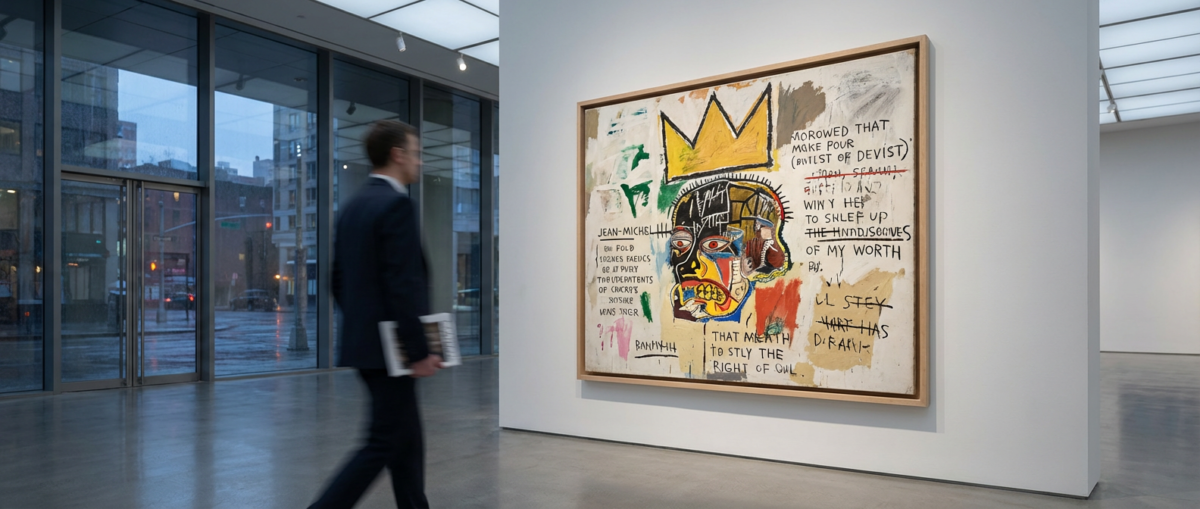
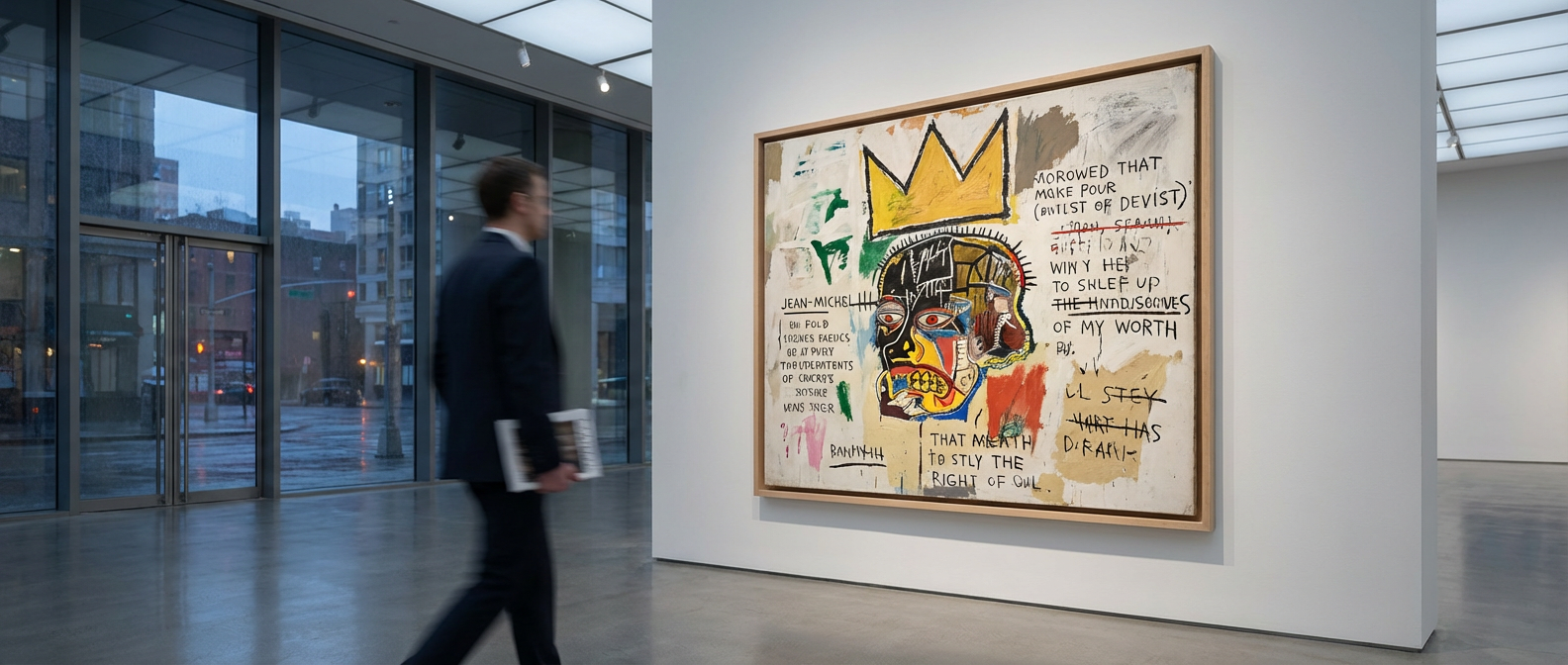
There is a particular species of institutional silence that speaks volumes. MoMA opened its first comprehensive solo retrospective of Jean-Michel Basquiat in late 2025, featuring over two hundred works spanning his brief career from 1980 to 1988. Standing before these paintings now, arranged across galleries with scholarly apparatus and curatorial intention, requires holding two truths at once: this exhibition is genuinely necessary, and its necessity points to a failure decades in the making. Basquiat died in 1988 at twenty-seven. MoMA waited nearly four decades before mounting a dedicated retrospective of this scale. The delay is part of the story.

MoMA's Basquiat Retrospective: Redemption, Reckoning, and What It Means to Finally Arrive
MoMA’s Basquiat Retrospective: Redemption, Reckoning, and What It Means to Finally Arrive

Think about what that timeline actually means. While his work sold for record-breaking prices at auction, while collectors and speculators transformed his paintings into financial instruments, the artist himself remained suspended in this strange category: commercially significant, institutionally homeless. This was not accidental. It is the particular trajectory reserved for certain artists, certain bodies, certain visions that the establishment eventually acknowledges while staying deeply ambivalent about the revolution they actually represent.

Illustration for MoMA's Basquiat Retrospective: Redemption, Reckoning, and What It Means to Finally Arrive
Illustration for MoMA’s Basquiat Retrospective: Redemption, Reckoning, and What It Means to Finally Arrive

The Market Spoke First, Museums Followed

The economics of Basquiat’s vindication follow a peculiar logic. In 2017, one of his untitled works from 1982 sold at Sotheby’s for $110.5 million, a record for an American artist at auction at that moment. The art market had already decided his worth. Collectors understood his historical importance. Dealers built empires around his scarcity. Yet the same institutional guardians who manage our cultural memory moved with glacial slowness, as though waiting for something to be settled that never quite needed settling.

That inversion matters. Museums are supposed to be the authorities on artistic significance, the places where market value and historical meaning separate. Instead, MoMA followed the market’s lead, arriving at its own retrospective like a guest showing up after the party ended. There is something almost apologetic about that sequence. The retrospective catalog, published by MoMA Press and running to four hundred pages with newly commissioned essays from scholars including Kellie Jones, reads partly as institutional reckoning, partly as an effort to reclaim narrative authority through sheer scholarly apparatus.

The Structural Problem: One Artist Among Many Absent

Focusing only on Basquiat’s case, though, misses the larger architecture of institutional neglect. An Artnet Intelligence Report examining museum acquisitions between 2008 and 2023 found that Black artists represent only 1.2 percent of works acquired by major U.S. museum collections during that period. Let that number sit for a moment. One point two percent. In a country where Black artists have been central to virtually every major American art movement of the twentieth and twenty-first centuries, from abstraction to conceptualism to street art, they occupy a tiny fraction of museum acquisitions across a fifteen-year span that includes the rise of social media, unprecedented access to image archives, and sustained critical attention to questions of institutional diversity.

Basquiat’s retrospective, then, is something more complex than a single artist finally receiving his due. It is a visible acknowledgment of a structural problem that stays largely invisible in the everyday operations of most institutions. The exhibition becomes a kind of proof of concept: yes, institutions can mount ambitious retrospectives of Black artists; yes, these shows can draw crowds and generate scholarship and shift conversation. But that proof exists against a backdrop of continued exclusion elsewhere. One major retrospective does not undo four decades of acquired caution.

What the Exhibition Actually Reveals

Walking through the retrospective, arranged chronologically and thematically across multiple galleries, something unexpected happens. The familiar narratives about Basquiat start to dissolve. He emerges not as the tragic prodigy, not as the street art phenomenon turned gallery darling, not as the Black artist who “made it” despite the odds. He appears as a working artist engaged in rigorous formal experimentation, deeply conversant with art history, explicitly responding to particular moments and movements and predecessors. His paintings reference Cy Twombly and Picasso, grapple with questions of abstraction and representation, engage with color theory and compositional strategies. The work is not less powerful for being rooted in serious artistic genealogy. It is more powerful.

You can see in the progression from his earlier works through 1988 an artist becoming more conceptually ambitious, more willing to push toward abstraction, more interested in what paint itself could do beyond representation. This is not the arc of a phenomenon burning out. It is the trajectory of an artist just beginning to fully inhabit his own vision. His early death becomes newly painful when you understand what directions he might have pursued.

Expensive Apology or Genuine Reckoning?

Any major museum retrospective of a historically marginalized artist raises the same question: is this genuine institutional reckoning or expensive apology? There is no clean answer. Any exhibition exists within a particular moment, within a particular institution’s constraints and politics and priorities. MoMA’s Basquiat show is real scholarship, genuine curatorial work, a meaningful contribution to how we understand this artist. It is also a PR move, a demonstration of institutional progressivism, a way of saying we acknowledge the problem without restructuring the systems that created it.

The more generous reading is that these things are not mutually exclusive. Institutions change incrementally. Retrospectives matter. They shape what gets taught in classrooms, what gets preserved in cultural memory, what young artists see as possible. Visit MoMA’s official Basquiat exhibition page to understand the scope of what this institution has chosen to commit its resources toward. And look at that commitment against the statistical reality: the Artnet Intelligence Report on museum diversity shows how far institutions still need to travel.

The most honest response to this retrospective is not to settle into either celebration or dismissal. This is necessary work. It is also incomplete work. It matters. And it should have happened decades ago. You might find yourself looking at a Basquiat painting and seeing not a tragic young genius but a careful artist thinking through color and form. You might also find yourself wondering what voices remain unheard, what archives remain uncurated, what artists are still waiting for their institutional arrival.

Categories
Main

MoMA’s Basquiat Retrospective: Redemption, Reckoning, or Merely Market Correction?

The Arithmetic of Absence

Late 2025 brought something to the Museum of Modern Art that should have arrived decades earlier: a comprehensive Jean-Michel Basquiat retrospective. Over two hundred works spanning the entirety of his brief but explosive career—from 1980 through 1988—finally occupied the kind of institutional real estate typically reserved for the safely canonized dead. The show is significant, a full accounting of what he made during those eight years when he transformed from a graffiti prodigy into a painter who forced the entire art world to reckon with its own blindness. But here’s the uncomfortable arithmetic: Basquiat died in 1988 at twenty-seven, which means this major retrospective arrived nearly four decades after his death. Four decades. That gap tells us something far more revealing than any critical essay could.

MoMA's Basquiat Retrospective: Redemption, Reckoning, or Merely Market Correction?
MoMA’s Basquiat Retrospective: Redemption, Reckoning, or Merely Market Correction?

The delay wasn’t born of lack. Basquiat’s market value has long announced his importance in the clearest language capitalism speaks. His untitled 1982 painting sold for $110.5 million at Sotheby’s in 2017, the highest price ever paid at auction for any American artist. Museums worldwide hold his work. Collectors pursue it with the single-mindedness usually reserved for religious relics. Yet MoMA, the institution that could have positioned itself as the authoritative voice on Basquiat decades ago, waited. And waited. This isn’t negligence exactly. It’s something more structural, more telling about how museums navigate the art historical canon when that art comes attached to a Black body, to street culture, to the anxieties of the mainstream art world.

Illustration for MoMA's Basquiat Retrospective: Redemption, Reckoning, or Merely Market Correction?
Illustration for MoMA’s Basquiat Retrospective: Redemption, Reckoning, or Merely Market Correction?

The Catalog as Conversation

The retrospective’s accompanying catalog, published by MoMA Press at four hundred pages, reads as something between confession and correction. Newly commissioned essays from scholars including Kellie Jones offer fresh interpretive frameworks for works that have been studied, bought, sold, and resold countless times already. You can feel the institution finally deploying its full scholarly apparatus toward an artist it had, in a meaningful way, neglected. The catalog isn’t a simple celebration. It reads as an extended meditation on what Basquiat’s work has always been asking us to see: the systems of power encoded in representation, the violence of exclusion, how artistic genius gets filtered through the machinery of institutional legitimacy.

What strikes me most when moving through Basquiat’s paintings is how little the work needs institutional endorsement, and how much it reveals about institutions that withhold it. His compositions draw from medieval manuscript illumination, anatomical texts, street signage, advertising language, and the visual vocabulary of Black vernacular culture. He builds meaning in layers, creating a visual shorthand for how knowledge gets organized, who gets to speak, whose voice gets heard. When you stand before these paintings—and you should, if you have any chance—you see immediately that Basquiat understood composition, color, and the weight of line in ways that connect back through the entire history of painting. He wasn’t a self-taught primitive discovering art accidentally. He was a painter working in conscious dialogue with artistic traditions, including especially the traditions that institutional museums had trained him to study.

The Numbers That Demand Interrogation

The broader context matters enormously. An Artnet Intelligence Report on museum diversity examined acquisition patterns at major U.S. museums between 2008 and 2023 and found that Black artists comprised only 1.2 percent of works acquired during that fifteen-year period. One point two percent. We’re living in a moment when those numbers have become increasingly visible, when institutions have begun publicly acknowledging their historical failures in representation. But these failures didn’t happen by accident. They were the product of repeated choices, institutional practices that valued certain aesthetics and certain bodies as more intrinsically worthy of preservation and study. Basquiat’s market triumph happened almost in spite of these institutional barriers, not because they fell away.

This is precisely what makes the MoMA retrospective so complicated to evaluate. The show is genuinely important. The scholarship is serious. The curation deserves attention and thought. But it arrives in a moment when the art market has already decided Basquiat’s value, when collectors have already bid his prices into the stratosphere, when the work has already proven itself commercially viable in ways that once seemed impossible. The retrospective doesn’t, can’t, correct the decades of institutional neglect. It acknowledges them. There is a difference.

What the Paintings Have Always Known

Yet here is where I resist the easy cynicism. The paintings themselves remain extraordinary. Standing before them, you feel the compression of visual knowledge, the urgent handwriting, the references piling up like palimpsest. Basquiat worked with the speed of someone who understood that time was short, that there was too much to say and not enough years to say it. Looking at these works now, as historical objects, we see more clearly what they were always attempting: a visual vocabulary for the experience of being hyperaware, of moving through systems designed to exclude you, of drawing from everything available, high art, low culture, medical texts, poetry, and making something entirely new from the collision.

MoMA’s official Basquiat exhibition page has the practical details: hours, dates, related programming. But the real question is what you do with the experience once you have it. The retrospective exists as both genuine achievement and mild institutional apology. Both things are true at once. Museums aren’t monoliths; they’re spaces where real scholarship and institutional blindness coexist. Our job as viewers is to move through these spaces with our eyes open, to notice what the paintings are doing, to ask ourselves what it means that we waited so long to clear wall space for genius that was always, unmistakably there.

The Elegy and the Afterlife

In the end, maybe this is Basquiat’s final gift to us: he teaches us to read the systems we inhabit, to see how power gets distributed, claimed, and withheld. The retrospective will close. The paintings will disperse back into private collections and other museums. But the catalog will remain, the scholarship will hold, and the work itself, that glorious, unsettled, endlessly generative work, keeps doing what it has always done. It insists on being taken seriously. It refuses diminishment. It demands that we look harder at the structures around us and ask why it took so long to see.

If you have thoughts about what this retrospective means for you—whether it changed how you see Basquiat’s work, whether you think institutional recognition matters, whether the timing feels redemptive or hollow—I’d genuinely love to hear it. Understanding art isn’t something curators finish. It’s something we all do together, across time, across galleries, in conversation with one another.

Categories
Main

The Monetization Debate: How Diablo Immortal’s Legacy is Reshaping Blizzard’s Mobile Strategy in 2025-2026

Before diving into the specifics, it’s worth establishing why this particular development sits at an intersection that arts audiences — more than most — are positioned to understand.

The Monetization Debate: How Diablo Immortal's Legacy is Reshaping Blizzard's Mobile Strategy in 2025-2026
The Monetization Debate: How Diablo Immortal’s Legacy is Reshaping Blizzard’s Mobile Strategy in 2025-2026

A Billion Dollars and a Damaged Reputation

Few games in recent memory have sparked as much controversy as Diablo Immortal. The design systems behind modern gacha games are more sophisticated than most players realize, and understanding them changes how you approach everything from team building to spending decisions. Diablo Immortal became the defining case study in how those systems can generate extraordinary revenue while simultaneously poisoning the well of player goodwill.

The context shapes everything. Let’s work through this together, step by step. Starting with that context makes the rest land harder.

By early 2025, the game had crossed a staggering milestone, accumulating more than one billion dollars in lifetime earnings. That number sounds like an unambiguous success. But according to data tracked by Sensor Tower – Diablo Immortal Revenue Milestones, the average amount spent per paying user dropped by 41% between 2022 and 2024. The game was reaching more people, but those people were spending far less. The whales were drying up, and the broader player base had grown wary of feeding a monetization machine they no longer trusted.

This tension between gross revenue and per-user spending tells a complicated story. A game can hit a billion dollars and still be in decline. For Blizzard, Diablo Immortal’s trajectory became less a trophy and more a warning signal about the long-term limits of aggressive gacha design.

Illustration for The Monetization Debate: How Diablo Immortal's Legacy is Reshaping Blizzard's Mobile Strategy in 2025-2026
Illustration for The Monetization Debate: How Diablo Immortal’s Legacy is Reshaping Blizzard’s Mobile Strategy in 2025-2026

Project Hades and the Pivot Away from Gacha

Blizzard is not ignoring those warning signals. A leaked investor document from Q3 2025 revealed an internal project called Project Hades, an unannounced mobile title that appears to be in active development. What makes this project worth paying attention to is its reported design philosophy. According to the document, the team is building the game around a battle pass model from the ground up, with the explicit goal of avoiding the PR fallout that plagued Diablo Immortal at launch.

That is a meaningful strategic shift. Battle passes offer players a clear value proposition. You pay a set price, you know exactly what you are getting, and progression feels earned rather than purchased from a slot machine. The randomized loot box systems that defined Diablo Immortal’s monetization created a fundamentally different psychological experience, one that many players found exploitative once they understood the odds stacked against them.

Choosing a battle pass framework is not just a PR decision. It reflects a growing recognition inside Blizzard that the studio’s mobile ambitions require a different kind of trust with players than the one Diablo Immortal ultimately destroyed. Project Hades, if it launches as described, would be the company placing a serious bet on transparent progression over probabilistic spending loops.

What Players Actually Want to Pay For

Player sentiment around mobile monetization has shifted considerably in recent years, and the data is starting to reflect that in concrete terms. A 2025 YouGov survey of four thousand mobile gamers across the United States found that 67% of respondents would rather pay a flat monthly fee of around ten dollars than engage with randomized loot box mechanics. That is a majority preference, and it is not a small one.

This preference points toward something worth sitting with. Players are not refusing to spend money on mobile games. They are refusing to spend money in ways that feel unpredictable and manipulative. A subscription or a battle pass gives them agency. Gacha mechanics remove that agency and replace it with engineered uncertainty. For a large segment of the market, that uncertainty has become a dealbreaker rather than an incentive.

Blizzard’s competitors have already picked up on this. Activision’s mobile segment, which includes Call of Duty Mobile, grew its revenue by 8% year over year in fiscal 2025, reaching 1.4 billion dollars. That growth was driven primarily by the game’s season pass structure rather than heavy reliance on randomized reward mechanics. The formula is not new, but the revenue results confirm it still works, and works in a way that avoids the reputational cost that comes with aggressive gacha design.

Regulation Is Catching Up to the Industry

Beyond player preferences, the regulatory environment around loot boxes and gacha mechanics is tightening in ways that developers can no longer afford to ignore. In June 2025, Apple updated its App Store guidelines to require that any game featuring gacha or randomized reward systems must display the full probability tables for those rewards directly on the game’s store listing page. Not buried somewhere inside the app. Not hidden behind a help screen. Front and center, before a player downloads anything.

You can review the specifics of those requirements in the Apple App Store Review Guidelines – Loot Box Policy, which now place meaningful obligations on developers publishing in this space. This kind of platform-level enforcement changes the calculus for any studio considering a gacha-heavy launch. When the odds are displayed prominently before a player ever opens the game, the psychology of the spend loop is fundamentally altered.

For Blizzard, this regulatory momentum makes the reported battle pass focus of Project Hades look less like a generous concession to players and more like a logical adaptation to market conditions. Designing around transparent monetization is no longer just ethically preferable. It is increasingly the path of least regulatory resistance on the platforms that matter most.

Where Blizzard’s Mobile Strategy Goes From Here

The legacy of Diablo Immortal is not simply a story about a controversial game. It is a blueprint that Blizzard appears determined to learn from rather than repeat. The billion-dollar revenue figure will likely be cited for years as proof that the original model worked on some level. But the 41% decline in per-user spending, the collapse in player trust, and the broader industry shift toward subscription and battle pass models all suggest that what worked in 2022 carries real limits in 2025 and beyond.

Project Hades signals something larger than a single game announcement. It marks a strategic inflection point for how one of the most recognizable names in gaming thinks about mobile players as an audience. Treating them as partners in a clear value exchange rather than targets in an optimized extraction system is a different kind of design ambition. Whether the execution will match the intention remains to be seen.

The mobile gaming market is large enough to reward multiple monetization philosophies at once. But the window for building lasting franchises on opaque gacha mechanics is narrowing, squeezed by player fatigue, platform regulation, and the demonstrated success of cleaner alternatives. Blizzard is watching all of this closely. The real question is whether Project Hades will arrive in time to matter, and whether it will hold to its reported principles once the pressure of live service economics kicks in.

The bigger picture connecting gaming trends, mobile entertainment, and digital culture is exactly what metatrend.app maps. If the questions this piece raises matter to you, that is a good place to continue the conversation.

The conversation about this is as valuable as the thing itself. Which piece surprised you most? Share below.

Categories
Main

MoMA’s AI Art Gamble: Are We Witnessing Progress or the Slow Death of Artistic Authenticity?

The Acquisition That Broke the Internet (And Probably Should Have)

Let’s talk about what happened in late 2024 when the Museum of Modern Art quietly added AI-assisted works to its permanent collection. I say quietly, but what I really mean is that the announcement landed like a grenade in a china shop, and the shards are still settling. The museum didn’t stage some grand press conference. No ribbon cutting or champagne toast. They simply updated their acquisition records, and suddenly every artist, curator, and hot take machine from here to the Venice Biennale was losing their collective mind.

MoMA's AI Art Gamble: Are We Witnessing Progress or the Slow Death of Artistic Authenticity?
MoMA’s AI Art Gamble: Are We Witnessing Progress or the Slow Death of Artistic Authenticity?

Here’s what fascinates me about this moment: it wasn’t actually surprising. Not really. MoMA had already been flirting with AI legitimacy for years. Refik Anadol’s ‘Unsupervised’ installation pulled over 800,000 visitors through the museum’s doors between 2022 and 2023. Eight hundred thousand people. That’s the kind of number that makes board members sit up straight and start thinking about expansion budgets. So when the acquisition finally happened, it felt less like a bolt from the blue and more like watching a marriage that everyone saw coming finally go official.

Illustration for MoMA's AI Art Gamble: Are We Witnessing Progress or the Slow Death of Artistic Authenticity?
Illustration for MoMA’s AI Art Gamble: Are We Witnessing Progress or the Slow Death of Artistic Authenticity?

What the Data Is Screaming (And What It Isn’t)

Let me lay down the numbers, because they tell an interesting story if you’re willing to listen carefully. The global AI art market hit approximately $1.2 billion in valuation during 2024. That’s real money. Real collectors. Real demand. Projections suggest this doubles by 2027, which means we’re not talking about a passing trend or some boutique corner of the art world. This is becoming infrastructure. Yet simultaneously, a 2025 survey from the College Art Association found that 67 percent of active visual artists believe AI-generated work deserves its own categorical designation in institutional collections. Not rejection. Not outright condemnation. Just separate shelving, essentially. Different labels.

That gap between market momentum and professional artist sentiment tells you something important: we haven’t actually solved the problem that everyone pretends is solved. We’ve just decided to move past it without resolution. That’s not progress. That’s avoidance with momentum.

The Open Letter That Nobody’s Talking About Enough

In 2025, the Artists Rights Alliance AI Statement went public with an open letter signed by over 3,000 artists. Three thousand. That’s not a fringe group. That’s a significant portion of the professional art community saying, in clear terms, that museums need to establish transparent provenance standards for AI works before acquisition. Not after. Not eventually. Before.

Read that carefully. They’re not saying no AI art ever. They’re saying: if you’re going to do this, you need rules. Clear ones. Rules that explain where the training data came from, whether living artists’ work was included without permission, what the algorithmic decision-making process involved. That’s a reasonable ask. It’s also an ask that MoMA appears to have largely sidestepped in pursuit of being first, or being bold, or whatever narrative they’re currently deploying.

The Betrayal Question, Answered Incompletely

So is this a betrayal? Yes and no, and the fact that I can’t give you a cleaner answer is precisely why this debate matters. It’s a betrayal to artists who have spent decades perfecting their craft, competing for gallery representation, fighting for acquisition into major collections, only to watch an algorithm achieve similar institutional validation in a fraction of the time. There’s real sting in that. There’s legitimate grievance. When you’ve sacrificed ten thousand hours to your work, seeing something generated in seconds earn equivalent museum space feels like watching someone hand your life’s work to a vending machine.

But is it a bold leap forward? Maybe also yes. Art institutions have always moved faster than the public wanted them to. Photography wasn’t considered art until it became economically viable and culturally undeniable. Performance art looked like nonsense until it stopped looking like nonsense. The question isn’t whether institutions should adapt to new forms. They should. The question is whether they’re adapting responsibly, with transparency, with genuine consideration for the artists whose labor and innovation built the foundation these AI systems are built upon.

What MoMA Actually Needs to Do Now

Here’s where the institution could go from defending a shaky position to actually earning the authority they’re claiming. They need to implement something resembling the transparency standards the Artists Rights Alliance is demanding. Check MoMA’s Collection Policy on New Media if you want to see what they’re currently working with, and you’ll notice some notable gaps. They need to clearly document which artists’ work was included in training data, whether permissions were obtained, what the decision-making algorithm prioritized. They need to fund research into the labor practices of AI art companies. They need to acquire work from traditional artists at equal rates.

Most importantly, they need to stop pretending this is a simple question with a simple answer. The interesting move isn’t choosing between human art and AI art. The interesting move is getting serious about what institutional responsibility actually looks like when you’re navigating genuinely new territory. That’s harder than just picking a side. That’s probably why it won’t happen as quickly as we’d like.

What’s your read on this? Are you watching this play out and thinking MoMA has finally caught up to where art is heading, or do you see something more troubling in how this decision was made? I’m genuinely interested in where you land, because unlike a lot of cultural arguments, this one has stakes that extend well beyond Twitter discourse.

Categories
Main

The Quiet Revolution Happening in Art Education: How RISD’s 2025 New Curriculum Is Dismantling the Studio Hierarchy

The Foundation Year That Wasn’t

Something significant quietly shifted in American art education this January, and you might have missed it scrolling past the news. The Rhode Island School of Design, one of the most influential art institutions in the country, announced a curriculum overhaul that dismantles something unchallenged for decades: the mandatory foundation year built entirely around learning to draw. Think about that for a moment. For generations, every art student who walked through RISD’s doors—all 2,300 of them—knew they would spend their first year learning to see through graphite and charcoal, building hand-eye coordination through endless still-life studies before they could even dream of touching paint or metal or code.

This wasn’t a tweak to the course catalog. RISD is replacing the whole foundation year with what they’re calling interdisciplinary entry studios. Students now choose from multiple pathways that mix drawing with digital media, material experimentation, conceptual thinking, and collaborative practice from day one. The shift feels quiet because it comes without fanfare, but it’s the kind of institutional change that ripples outward for years, reshaping how thousands of young artists think about what it means to begin.

The Skills Gap That Nobody Talked About Until Now

Here’s what haunted art schools silently for years: students were graduating with extraordinary technical skills and almost zero preparation for the actual business of being an artist. A 2024 study by the National Endowment for the Arts surveyed recent graduates and found something sobering. Two-thirds of them—sixty-seven percent—reported feeling completely unprepared to handle the administrative and business demands of professional art careers. They could render light beautifully. They understood composition in their bones. But they didn’t know how to write a grant proposal, manage studio finances, navigate contracts, or build sustainable income streams.

This gap between artistic mastery and professional literacy became even more visible as the economics of art education began to crack. At Yale School of Art, tuition for the 2025-2026 academic year reached forty-four thousand, five hundred dollars annually. That number hangs in the air like a warning. When you’re spending that much money to study art, the question stops being theoretical. It becomes urgent: am I learning what I actually need to build a life from this? The public conversation about accessibility and student debt in MFA programs wasn’t nostalgic. It was panicked.

The Enrollment Question Nobody Expected

The decline crept in quietly, too. Over the past three years, according to the College Art Association’s 2025 annual report, MFA applications dropped fourteen percent nationally. That might not sound catastrophic until you consider what it means: fewer people are choosing advanced art degrees. The reasons cluster around two fears that feed each other. Career uncertainty. Cost. When you combine skyrocketing tuition with graduates who don’t feel prepared to sustain themselves, young artists start asking uncomfortable questions about whether the degree is worth the debt.

RISD’s new approach feels like an institution listening to this conversation and deciding to respond, not by lowering standards but by rethinking what standards should look like. The College Art Association tracks these trends closely across member institutions, and what’s happening at RISD matters because similar conversations are starting everywhere.

Ecological Literacy as the New Foundation

Here’s where the 2025 curriculum redesign gets genuinely interesting. RISD made the unprecedented decision to integrate ecological literacy as a required strand across every single department. Graphic design students. Sculpture students. Fine art painters. Industrial designers. Fashion majors. Every one of them will now engage explicitly with environmental frameworks, sustainability thinking, and the ecological impact of their practice. This isn’t elective. It’s woven into the foundation itself.

RISD is the first major U.S. art school to mandate environmental frameworks institution-wide, and you can feel the weight of that decision. It’s not a separate course labeled “Art and Ecology” that students check off their requirements. It’s a through-line asking: where does this material come from? Where does it go when I’m finished? What’s my responsibility to the systems that made my art possible? These aren’t comfortable questions, and they shouldn’t be. They dismantle the romantic myth of the artist as isolated genius and replace it with something more honest: the artist as someone embedded in networks of consequence.

Suddenly, understanding supply chains matters as much as understanding chiaroscuro. A student designing a poster needs to think not just about how it communicates but about how it gets produced, distributed, and eventually discarded. The studio hierarchy that always privileged pure visual mastery above everything else begins to flatten.

What This Means for How We Think About Art Training

The old model assumed a certain path: learn the fundamentals through drawing, build technical competency, then gradually expand into broader thinking about meaning and context and the world. RISD’s new curriculum says that expansion should begin before you ever arrive on campus. Ecological thinking isn’t advanced material. It’s foundational. Business literacy isn’t a compromise with artistic purity. It’s part of artistic responsibility. The old hierarchy, where drawing sat at the top of the pyramid and everything else flowed downward, was never as natural as it seemed.

Nothing here requires artists to stop drawing. RISD Academic Programs still include rigorous drawing education. But it’s no longer the gatekeeping requirement, the test you have to pass before you’re allowed to think about anything else. Drawing becomes one language among many, one tool among many, mixed from the beginning into a broader ecosystem of artistic learning that includes making, thinking, questioning, and understanding impact.

If you’ve been watching art education with any attention, you know this moment matters. College Art Association members across the country are already having intense conversations about what RISD’s move means for their own institutions. This isn’t about abandoning excellence. It’s about asking what excellence should include, and who gets to decide. What questions are you sitting with about this shift? I’d love to hear what you think about where art education goes from here.

Categories
Main

Why Pantone’s Mocha Mousse Moment Should Make Artists Uncomfortable

The Machine Turns, and Everyone Follows

In December 2024, Pantone announced Mocha Mousse as its Color of the Year, and within weeks, the art world collectively nodded as if a verdict had been handed down from on high. The company described this warm, indulgent brown as a balm for global uncertainty, a visual respite in turbulent times. By mid-January, Google searches for “brown paint palette art” and “earth tone color theory” had spiked 340 percent in the United States alone. Interior designers began rethinking their palettes. Artists started pulling reference images. Everyone wanted to know: how do I make Mocha Mousse work for me?

Why Pantone's Mocha Mousse Moment Should Make Artists Uncomfortable
Why Pantone’s Mocha Mousse Moment Should Make Artists Uncomfortable

Here is what troubles me about this entire choreography. The color itself is perfectly fine, a sophisticated, genuinely appealing shade with historical precedent and real aesthetic merit. But the mechanism that put it there, the industrial consensus-building that made it feel inevitable, deserves scrutiny. Because what happened in those six weeks was not a grassroots artistic movement. It was the mathematics of influence meeting the psychology of validation.

Pantone’s Color Institute, the division responsible for this annual pronouncement, did not even exist until 2000. The company itself began as a color matching system in 1963, created by Lawrence Herbert to solve a specific practical problem: how to standardize inks for the printing industry. That system, PMS Pantone, was genuinely useful. It gave manufacturers a shared language. But somewhere along the line, the tool became the arbiter, and the arbiter became the taste-maker.

Illustration for Why Pantone's Mocha Mousse Moment Should Make Artists Uncomfortable
Illustration for Why Pantone’s Mocha Mousse Moment Should Make Artists Uncomfortable

The Replacement of Genuine Criticism

Art historian Sasha Archibald made a bracing argument in The Brooklyn Rail Art Criticism this past January. She suggested that Pantone’s annual color selections have functionally replaced actual art critical discourse in shaping consumer aesthetics. Think about that for a moment. Art criticism, the careful, often contentious conversation between writers, curators, and artists about what matters and why, has been gradually outsourced to a corporation’s marketing calendar.

This is not paranoia. It is the observable result of institutional consolidation meeting the attention economy. When a design student opens her laptop to research color theory for a project, she no longer begins with art history texts or museum archives. She begins with Pantone. When an architect sits down with a client to discuss the emotional tenor of a space, Pantone’s language is already there, pre-packaged and validated. The color has come with its own story, its own justification, its own cultural permission slip.

The mechanics are elegant precisely because they are invisible. Pantone does not force adoption. Instead, it creates desire through the promise of understanding. To choose Mocha Mousse is to be part of something larger than yourself, to be aligned with a global consensus about beauty and appropriateness. Designers and artists participate willingly because the alternative, choosing a color and defending it on your own terms, feels riskier and lonelier.

When Standardization Becomes Limitation

A 2024 study published in Color Research and Application examined how standardization systems like Pantone actually shape decisions across industries. In residential design projects specifically, these color matching systems influenced material selections in 74 percent of surveyed projects. That is not 74 percent of designers consciously choosing to use Pantone. That is 74 percent of projects where the existence of standardized color systems, the infrastructure of coordination they provide, shaped the outcome.

Here is what gets lost in that efficiency. The artist working intuitively, mixing pigments until she arrives at something that feels true to her vision but cannot be labeled or coordinated across a supply chain. The designer who chooses a slightly “wrong” color because it speaks to something specific about a particular building in a particular light. The architect who understands that brown is not one thing. It is clay, rust, shadow, leather, tree bark, and each carries a different weight and resonance.

When standardization becomes the baseline expectation, deviation reads as risk rather than vision. Young artists especially internalize this calculus without always realizing it. The message is subtle but persistent: there is a right answer, and it comes from outside yourself. Your eye, your training, your instinct exists to recognize and execute that answer well, not to question it or offer alternatives.

The Seduction of Validation

I want to be honest about why Pantone’s Color of the Year matters so much to so many people, artists included. It offers something genuinely valuable: permission. In a chaotic cultural moment, it says, “This is the color. This is what beauty looks like right now. You can trust this.” That is not nothing. Validation is a real need, and the loneliness of creative work is a real fact.

But here is what concerns me more. The more we accept external validation for our aesthetic choices, the quieter our own eye becomes. I am not arguing for some naive romanticism about pure artistic vision uncorrupted by the market or by institutional influence. That ship sailed centuries ago, if it ever existed at all. What I am arguing for is consciousness about the forces at work.

When you choose a color because Pantone blessed it, you are choosing something different than when you choose a color because you studied Renaissance paintings and noticed how Caravaggio used ochre and umber to create spatial depth, and you want to understand that technique in your own work. The outcomes might look identical. The internal logic is completely different. One is received wisdom. The other is earned knowledge.

What Artists Can Do Instead

The answer is not to reject Mocha Mousse or to pretend that Pantone Color of the Year 2025 does not exist. The color is genuinely lovely, and if it speaks to your work, use it with full confidence. The answer is to develop an equal or greater investment in color choices that cannot be standardized. Spend time in museums looking at how actual painters solved color problems across centuries. Notice the specific brown of a Rembrandt shadow or the ochre in a Cy Twombly background. Ask yourself why those choices feel inevitable in those contexts.

Read color theory not as instruction but as conversation. Study how traditional cultures developed color systems based on available materials and light conditions, how desert regions used different palettes than forests, how northern light demanded different relationships between warm and cool tones than Mediterranean sun. There are many correct answers, not one.

Most importantly, practice trusting your eye over the consensus. Mix colors that are slightly off, that do not have a Pantone number attached. Use them anyway. Let your work sometimes be out of step with the moment. The artists whose work holds up across decades are rarely the ones who captured the aesthetic consensus of their time. They are the ones who saw something before the machinery caught up, or who refused to see what everyone else saw, or who developed such a distinctive relationship with color and form that they made the consensus shift to meet them.

What do you think? Are you conscious about how much institutional color standardization shapes your own aesthetic choices? I would genuinely like to know how other artists navigate this tension between access to shared language and the preservation of individual vision. The conversation matters more than the color.