The Acquisition That Broke the Internet (And Probably Should Have)
Let’s talk about what happened in late 2024 when the Museum of Modern Art quietly added AI-assisted works to its permanent collection. I say quietly, but what I really mean is that the announcement landed like a grenade in a china shop, and the shards are still settling. The museum didn’t stage some grand press conference. No ribbon cutting or champagne toast. They simply updated their acquisition records, and suddenly every artist, curator, and hot take machine from here to the Venice Biennale was losing their collective mind.
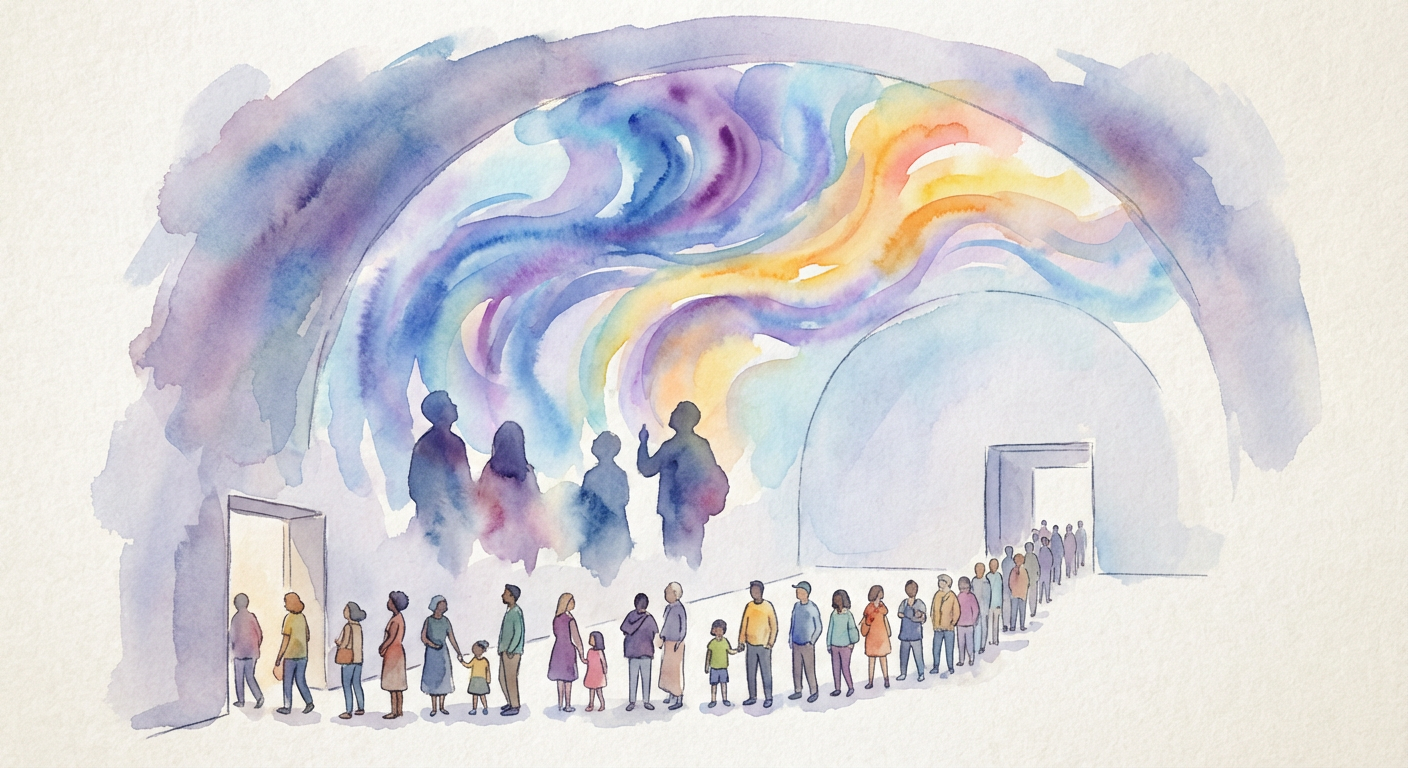
Here’s what fascinates me about this moment: it wasn’t actually surprising. Not really. MoMA had already been flirting with AI legitimacy for years. Refik Anadol’s ‘Unsupervised’ installation pulled over 800,000 visitors through the museum’s doors between 2022 and 2023. Eight hundred thousand people. That’s the kind of number that makes board members sit up straight and start thinking about expansion budgets. So when the acquisition finally happened, it felt less like a bolt from the blue and more like watching a marriage that everyone saw coming finally go official.
What the Data Is Screaming (And What It Isn’t)
Let me lay down the numbers, because they tell an interesting story if you’re willing to listen carefully. The global AI art market hit approximately $1.2 billion in valuation during 2024. That’s real money. Real collectors. Real demand. Projections suggest this doubles by 2027, which means we’re not talking about a passing trend or some boutique corner of the art world. This is becoming infrastructure. Yet simultaneously, a 2025 survey from the College Art Association found that 67 percent of active visual artists believe AI-generated work deserves its own categorical designation in institutional collections. Not rejection. Not outright condemnation. Just separate shelving, essentially. Different labels.
That gap between market momentum and professional artist sentiment tells you something important: we haven’t actually solved the problem that everyone pretends is solved. We’ve just decided to move past it without resolution. That’s not progress. That’s avoidance with momentum.
The Open Letter That Nobody’s Talking About Enough
In 2025, the Artists Rights Alliance AI Statement went public with an open letter signed by over 3,000 artists. Three thousand. That’s not a fringe group. That’s a significant portion of the professional art community saying, in clear terms, that museums need to establish transparent provenance standards for AI works before acquisition. Not after. Not eventually. Before.
Read that carefully. They’re not saying no AI art ever. They’re saying: if you’re going to do this, you need rules. Clear ones. Rules that explain where the training data came from, whether living artists’ work was included without permission, what the algorithmic decision-making process involved. That’s a reasonable ask. It’s also an ask that MoMA appears to have largely sidestepped in pursuit of being first, or being bold, or whatever narrative they’re currently deploying.
The Betrayal Question, Answered Incompletely
So is this a betrayal? Yes and no, and the fact that I can’t give you a cleaner answer is precisely why this debate matters. It’s a betrayal to artists who have spent decades perfecting their craft, competing for gallery representation, fighting for acquisition into major collections, only to watch an algorithm achieve similar institutional validation in a fraction of the time. There’s real sting in that. There’s legitimate grievance. When you’ve sacrificed ten thousand hours to your work, seeing something generated in seconds earn equivalent museum space feels like watching someone hand your life’s work to a vending machine.
But is it a bold leap forward? Maybe also yes. Art institutions have always moved faster than the public wanted them to. Photography wasn’t considered art until it became economically viable and culturally undeniable. Performance art looked like nonsense until it stopped looking like nonsense. The question isn’t whether institutions should adapt to new forms. They should. The question is whether they’re adapting responsibly, with transparency, with genuine consideration for the artists whose labor and innovation built the foundation these AI systems are built upon.
What MoMA Actually Needs to Do Now
Here’s where the institution could go from defending a shaky position to actually earning the authority they’re claiming. They need to implement something resembling the transparency standards the Artists Rights Alliance is demanding. Check MoMA’s Collection Policy on New Media if you want to see what they’re currently working with, and you’ll notice some notable gaps. They need to clearly document which artists’ work was included in training data, whether permissions were obtained, what the decision-making algorithm prioritized. They need to fund research into the labor practices of AI art companies. They need to acquire work from traditional artists at equal rates.
Most importantly, they need to stop pretending this is a simple question with a simple answer. The interesting move isn’t choosing between human art and AI art. The interesting move is getting serious about what institutional responsibility actually looks like when you’re navigating genuinely new territory. That’s harder than just picking a side. That’s probably why it won’t happen as quickly as we’d like.
What’s your read on this? Are you watching this play out and thinking MoMA has finally caught up to where art is heading, or do you see something more troubling in how this decision was made? I’m genuinely interested in where you land, because unlike a lot of cultural arguments, this one has stakes that extend well beyond Twitter discourse.