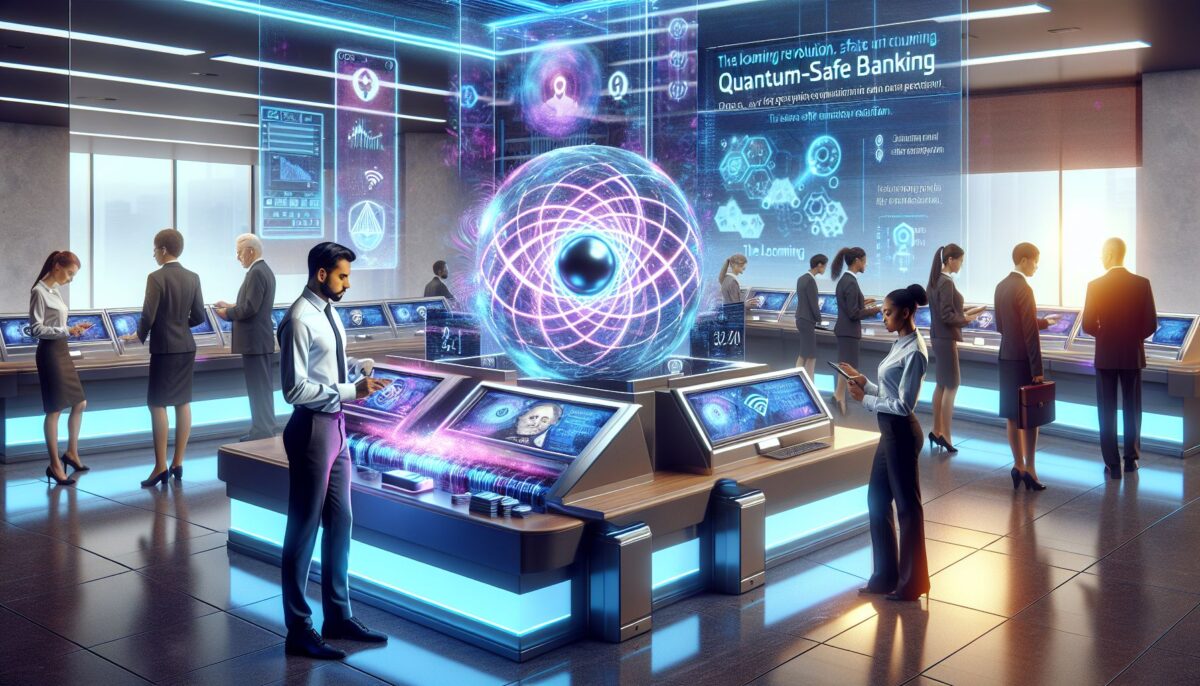
Introduction: Enter the Quantum Era
So, imagine you’re comfortably cruising down a digital highway in your Tesla, and suddenly, BAM! You hit 88 mph and find yourself hurtling through a loop-de-loop in a dystopian Euclidean universe. No, it’s not a deleted scene from “Back to the Future.” It’s the reality we could face when quantum computing hits its stride, and your friendly neighborhood encryption systems come crashing down like an inexplicably gelled house of cards.
Let’s dive into the rabbit hole of quantum-safe banking, a potentially massive shift that’s not just coming, it’s practically knocking at our door with a battering ram made of qubits. Spoiler: It’s more than just swapping out your digital locks. This is about redefining the very fabric of financial security, governance, and international trust systems.
The Quantum Threat: A Clear and Present Danger
First things first—just how screwed are we? Traditional encryption methods, you know, the trusty RSA and ECC that we’ve been pals with for decades, are built on the mathematical equivalent of stopping to watch grass grow. Complex, sure, but not unbreakable—just time-consuming unless you’re a quantum computer that can crack codes faster than you can say “blockchain.”
With a sufficiently powerful quantum computer, we’re talking about the potential to decrypt almost any classical encryption in polynomial time. Translation? Secrets get spilled, proverbial underwear drawers get raided, and financial institutions must face their own version of the Y2K bug… on steroids and caffeine.
The Post-Quantum Playbook: Preparing for a Not-So-Distant Future
Now, nobody wants to be the financial equivalent of Napster. To avoid a collective cry of “Uh-oh,” financial institutions are frantically drafting contingency plans as if they’re trying to win a Nobel in Crisis Management. The solution? Enter the mysterious realm of post-quantum cryptography (PQC).
PQC involves algorithms that are currently too complex for even quantum computers to decipher—think of it as our tech equivalent of playing hide-and-seek with a toddler who counts perpetually. We’ve got lattice-based cryptography, hash-based cryptography, and my favorite, the monolithic-sounding isogeny-based cryptography, all vying for the proverbial throne in this new quantum-safe kingdom.
The Regulatory Domino Effect
Alright, so we’re whipping up quantum-safe algorithms like they’re the next artisanal bread trend. But let’s pump the brakes a bit—what do regulators have to say? The world’s governing bodies have a knack for moving at the pace of a glacier in slow motion. This time, however, even they can’t afford to dawdle.
Geopolitics play a key role here. Whoever achieves quantum supremacy first doesn’t just get bragging rights, they gain a seat at the table directing global policy. Bodies like the European Union and the U.S. National Institute of Standards and Technology (NIST) are leading efforts to standardize PQC algorithms. Still, how we implement them hinges on a delicate ballet of international collaboration, trust, and even cyber espionage.
Playing the Long Game: Market Ramifications
Let’s zoom out and see the forest for the trees. Beyond the tech jargon and regulatory whack-a-mole is an undeniable reality: entire markets stand on shifting sand. Transitioning to a quantum-safe infrastructure is not merely an upgrade. It’s like switching from horse-drawn carriages to Teslas overnight. Early movers in quantum-safe tech could see significant first-mover advantages—think of them as the early days of the dot-com bubble, but with memes that are even more impenetrable.
Financial institutions that double down on investments in quantum safety not only protect themselves but likely secure a leading position in a market suddenly flanked by new barriers and reduced competition. The question is, who will take that first leap into the quantum divide?
Takeaway: Future-Proofing Financial Security
Alright, let’s land the quantum starship, shall we? The race towards quantum-safe banking is more than just a cat-and-mouse game with future cryptography. It’s about reshaping trust, redefining global finance, and quite literally future-proofing our economic infrastructure in a world that won’t wait for stragglers.
The big takeaway? Treat quantum-safe protocols like your social security number in Vegas—handle with care but be ready to roll the dice when the odds shift to your favor. Or as I like to say, “Bet on the qubit, or get left in the binary dust.”
Ending Question for the Quantum-Curious
So, fellow futurists and code wranglers, where do you stand? Is the rising wave of quantum computing a genuinely existential threat, or just the next challenge in our tech symphony? Can quantum-safe algorithms lay the building blocks for an unbreakable financial future, or are we too busy playing catch-up to stop what seems all but inevitable? Let me know your thoughts, and dare to think beyond.