Categories
Main

The Quantum Bucks Paradox: Is Quantum-Safe Banking The Future or a Pipe Dream?

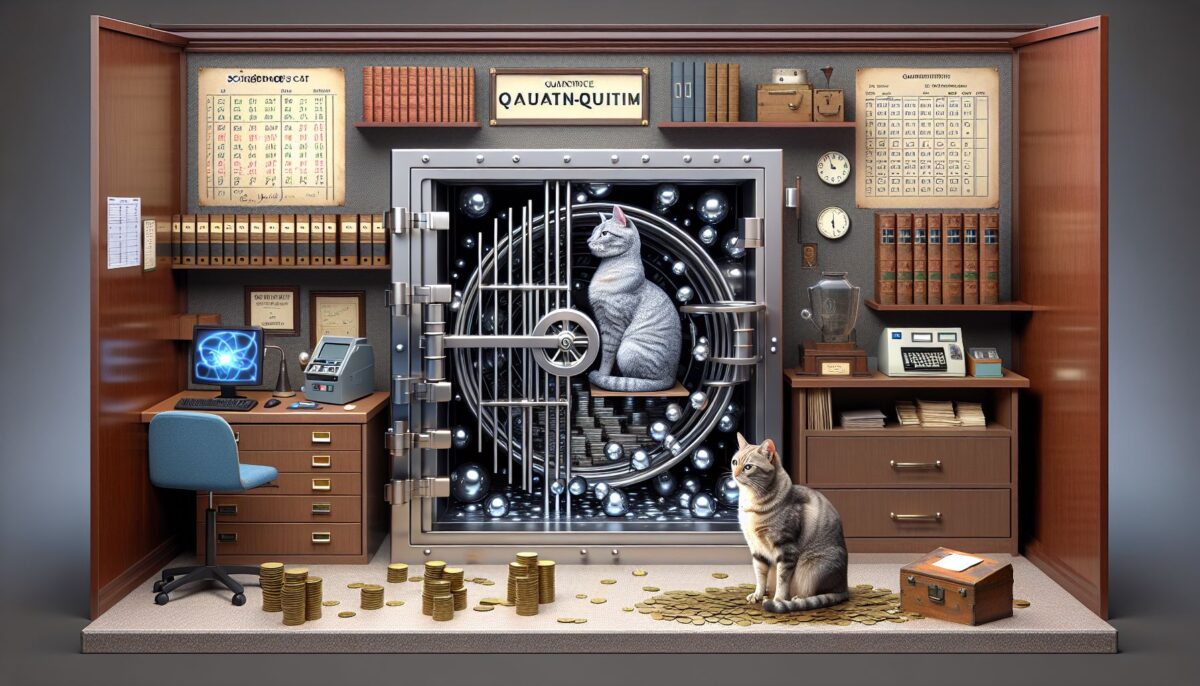
Ah, the romance of Schrödinger’s cat—alive and dead at the same time. Like many quantum lovers, the very mention of “quantum” sends me down a rabbit hole of hypothetical imagination, theoretical fireworks, and perhaps a dash of nerdy coffee-induced mania. But when it comes to quantum-safe banking, we’re no longer just speaking in hypotheticals. We’re at a cliff’s edge, one where Schrödinger’s cat might just open a bank account.

When Cryptography Meets Quantum Computing

Remember when RSA encryption felt as unbreakable as a Chuck Norris roundhouse kick? Well, quantum computing is about to rewrite that story with something less than a gentle nudge. The power to perform complex calculations almost instantly makes quantum computers both a fintech builder’s dream and a banker’s nightmare.

Classical cryptographic methods rely on the inability of classical computers to factorize large numbers fast enough to break encryption. Now imagine a quantum computer doing in minutes what would have taken centuries. We can’t just ignore the thundering footsteps of qubits marching our way.

Regulation: The Quantum Fallacy or Necessity?

Picture this: international financial regulators scrambling like a DJ at a wedding when they play a song nobody likes. Quantum-safe banking presents a wild dilemma. On one hand, regulators want to encourage innovation. On the other, they don’t want a scenario where financial systems are as vulnerable as a Windows XP computer on today’s internet.

The regulatory world, therefore, must change almost in step with technology. But can policy ever really keep pace with qubit developments? Here’s where I toss in my tinker’s hat: regulators could create sandbox environments for quantum technologies. Regulatory experiments could free up quantum innovation while putting up guardrails at the same time. This is no small feat, but who said reshaping the financial universe was easy?

The Goggles of Geopolitics: GovTech’s Quantum Gamble

Let’s chat geopolitics. While quantum-decrypted chaos isn’t exactly on the 10 p.m. news yet, it’s lurking. Quantum computing might give countries that master it a Houdini-grade advantage in finance, cybersecurity, and even defense.

Nations are pouring billions into quantum research, locked in a tech Cold War of sorts. And yet, with all this mad scrambling, no one has quite perfected a scalable, practical quantum machine. What happens when someone does? Veni, vidi, vici of macroeconomics, or a crash setting the stage for tension-fueled drama?

Governments face the massive task of prioritizing cybersecurity, protecting market mechanisms, and strengthening alliances in this quantum era. Cohesive, international cyber-treaties could be our next frontier, or possibly our next punchline.

Market Structure: Too Big to Qubit?

Old-school banking calls for dematerialized bits of currency backed by centralized institutions. Quantum-safe banking forces us to rethink these structures. Yes, banks can adopt quantum-resistant algorithms, but doing so means navigating structural changes no less complex than overhauling a spaghetti code system some intern wrote in 1995.

Companies have to migrate financial data to quantum-resistant protocols and design infrastructures ready for quantum reality. The elephant in the room, however, remains: readiness. With all these financial institutions talking up digital transformation, we have to wonder: are they all singing the same tune, or are they bluffing with two pairs?

Ironically, quantum safety could become a new form of market competition, similar to the mobile phone wars, if you could call it that, of who can create the most meme-worthy encryption protocol.

The Final Bent Spoon: Our Financial Future

The ripple effects of quantum computer intrusion on financial systems could be as revolutionary as automating a pizza oven, but the tasty results are worth the burn risks. Imagine financial transactions becoming instant, investments with a turnaround as fast as quantum quarks themselves, and markets operating at IQ levels best left to sci-fi writers.

Yet, with great potential comes endless challenges. Countries may regulate at different speeds, cybersecurity may become its own arms race, and we builders will need our hustle game as strong as our innovation game.

So, fellow coders and fintech dwellers, what do you make of our quantum path? Is this Schrödinger-scenario all hype and helium, or are we on the brink of a cold, hard quantum reality check? Let’s jump into the comments and unpack your quantum take.

Categories
Main

Quantum-Safe Banking: The Next Frontier in Financial Security

Hey there, fellow builders and dreamers! Today, we’re talking about something that’s both fascinating and frankly a little terrifying: Quantum-Safe Banking. Quantum computing isn’t some distant sci-fi concept anymore. It’s real, it’s coming fast, and it’s going to change everything about how we think about digital security. So how do we make sure our banking systems don’t become sitting ducks?

Welcome to quantum-safe encryption, where cutting-edge finance meets physics that would make Einstein’s head spin. Grab your coffee and let’s dig into this together.

The Quantum Threat: Banks in the Crosshairs

First, let’s talk about why everyone’s freaking out. Our entire digital security system relies on math problems that are really, really hard for regular computers to solve. That’s what keeps your bank account safe right now.

But here’s the kicker: quantum computers, armed with something called Shor’s algorithm, can solve these “impossible” math problems like they’re doing basic addition. We’re talking about calculations that would take today’s best computers thousands of years, solved in hours or minutes.

What does this mean for banks? Every credit card transaction, every online transfer, every encrypted piece of financial data could be cracked wide open. If your bank security feels rock-solid today, quantum computers are about to turn it into Swiss cheese.

Battle Plans: Quantum-Safe Cryptography

So what’s the plan? We fight quantum with quantum-safe cryptography. Think of it as building a new kind of lock that even quantum computers can’t pick.

Instead of relying on the old math problems that quantum computers will demolish, these new systems use different approaches. There’s lattice-based cryptography, hash-based systems, and multivariate equations that make quantum attacks look like bringing a knife to a gunfight.

Here’s the thing though: switching to quantum-safe systems isn’t like updating an app on your phone. Banks need to rebuild their entire security infrastructure while keeping everything running smoothly. It’s like changing the engine of a car while driving down the highway. Complicated doesn’t begin to cover it.

Regulatory Ripples and Policy Waves

And then there’s the regulatory nightmare. Because nothing in finance happens without a mountain of red tape, right?

Different countries are going to want different quantum-safe standards. The US will have its approach, the EU will have theirs, China will do something else entirely. We could end up with a mess where quantum-safe banking works differently depending on where you are in the world.

International cooperation is going to be huge here. Groups like the Financial Stability Board need to step up and create some unified guidelines. Otherwise, we’re looking at a regulatory spaghetti bowl that makes today’s crypto compliance issues look simple.

Innovator Incentives: Who Pays For Your New Armor?

Let’s be honest about the elephant in the room: this stuff is expensive. Small fintech companies can’t just wave a magic wand and quantum-proof their systems overnight.

This is where smart government policy could make a real difference. Tax breaks for early adopters, subsidies for quantum-safe upgrades, maybe even special insurance rates for companies that get ahead of the curve. Think of it like the tax credits that helped solar energy take off, but for cryptography.

Cybersecurity insurance is already becoming a big deal in finance. I wouldn’t be surprised if quantum-safe protocols become a requirement for getting coverage, or at least for getting reasonable rates.

The Spiraling Impact on Market Structures

This isn’t just about swapping out some code. Quantum-safe banking is going to change how the entire financial system works. Trading systems, data storage, even what we consider a valid digital signature, all of it needs to be rethought.

There’s a human element here too. We need developers who understand quantum cryptography, regulators who can wrap their heads around the technology, and financial professionals who can explain all this to nervous customers. The technical complexity is one thing, but the communication challenge might be even bigger.

Conclusion: A Call To Code

Quantum-safe banking isn’t optional. It’s not some nice-to-have feature we can put off until next year. It’s the foundation that our entire financial future is going to be built on.

The crypto systems protecting your money today have an expiration date, whether we like it or not. By getting serious about quantum-safe solutions now, we’re building the infrastructure that keeps finance working when the quantum revolution hits full speed.

So here’s my question for you: what do you think this quantum transition is going to look like? Are we heading for a smooth evolution or a chaotic scramble? Will we pull this off, or are we setting ourselves up for some spectacular failures along the way?

Drop your thoughts in the comments. I’m curious to hear what you think about our quantum future!

Categories
Main

The Quantum Awakening: Harnessing Quantum Computing in Financial Strategies

Alright, fellow renegades of the code cosmos, gather ’round as we dig into what I consider the wild collision of finance and technology. We’re going to tinker under the hood of something that could change everything: quantum computing. No, this isn’t your run-of-the-mill “qubits and chill” session. It’s an exposé on how quantum computing might completely overhaul asset management before your morning coffee goes cold.

The Promise of Quantum Finance

Quantum computing in finance isn’t a thing of the distant future. Nope, it’s the sleek sports car silently cruising under your radar. While traditional computers calculate with 0s and 1s in a linear fashion, quantum computers use qubits that frolic in the spooky realm of superposition and entanglement. This remarkable feature can process more information in moments than today’s supercomputers could in a lifetime. It’s like finishing a GitHub page load while the coffee’s still brewing.

Basically, this genie we’ve uncorked might completely reshape asset management by optimizing portfolio strategies, managing risks, and even decoding market patterns with scary precision.

Navigating the Regulatory Swamp

Before we start cashing out our buy-in-the-dip fantasies, there’s a dense jungle of regulation waiting to trip us up. The regulatory framework around quantum computing and finance needs a serious revamp. Currently, it’s like trying to navigate with a decade-old roadmap: not impossible, but hilariously ineffective.

Policymakers are scratching their heads, wondering how to classify and legislate emerging quantum tech without killing innovation. And you can bet your bottom bitcoin that savvy fintech firms are already lobbying for regulations that are as frictionless as possible. Yes, dear coder, we’re going to need regulatory fact-checkers as much as our favorite debug tools.

Quantum on the Geo-Political Chessboard

In the global race to quantum supremacy, countries are battling on a geopolitical chessboard, each wanting to checkmate the financial world first. The U.S. and China are practically neck and neck, throwing money and minds at quantum research like it’s a Black Friday sale. But what about other nations? Well, think of them as the silent players. They’re not asleep, just strategically biding time, maybe even planning for a fast follower win.

As investors, we need to understand how geopolitical movements in quantum research funding impact currency fluctuations, interest rates, and ultimately, global financial stability.

Market Dynamics: The New Powerplay

Quantum computing’s entrance to asset management is like that newcomer hacker who waltzes in and upends the entire local scene. Current market structures, with their traditional trading models and risk parameters, are about to get their foundation challenged. Big time.

Imagine an AI-driven system with quantum capabilities analyzing diverse data streams to predict market trends with pin-point accuracy. Sounds like a dream machine, right? But it could also lead to serious market volatility. Unpredictably fast trades and outcomes might present new stress tests for our existing economic frameworks.

The qubit dreams that we spin at our code editors are going to have real-world consequences. As quantum unleashes its power into finance, the markets are going to ripple like crazy.

Coding the Quantum Recipe

All’s not lost in terms of getting an early edge in the quantum realm. Here’s where you, the audacious software sorcerers of the future, come in. Joining this evolution means working with interdisciplinary teams that bring together quantum physicists, financial engineers, and coders.

Don’t be afraid to remix your skill set. Quantum algorithms are waiting for innovators to create proprietary applications built on not just bleeding edge code but quantum-inspired frameworks that marry finance and technology into something truly innovative.

What’s Next

Moving forward with quantum computing can create amazing possibilities for optimizing assets, managing portfolios, and even shifting the scope of financial security like never before. Yet, it requires a careful assessment of the macroeconomic scale, policy ramifications, and definitely our role as architect coders who turn this towering quantum tech into practical solutions.

As we forge this path, how do you see your place in a world where quantum-financial masterminds reign supreme? Are you ready to be part of this evolution, or will you stick with today’s methodologies as the quantum tide rushes in?

Let the comments ignite with your visions, thoughts, and yes—meme-worthy predictions of quantum-powered finance.

Categories
Main

Guardian Nodes and DAO Democracy: Decentralizing Governance for the Financial Future

Good morning, innovators, dreamers, and crypto-anarchists! Have you ever dreamed of a world where financial governance is as democratic and transparent as a town hall meeting that runs on blockchain? A world where power isn’t just taken out of dinosaur boardrooms but shared amongst everyday coders and visionaries? Welcome to the thrilling intersection of blockchain governance and decentralized autonomous organizations (DAOs), where guardian nodes guide the financial ships of tomorrow.

The Dawn of Decentralization

We’re at the cusp of something special, folks. It’s like watching the first electric currents snake along copper wires or glimpsing a pixelated Pong ball dance across screens. The power of decentralized finance is charging through the wires, ready to transform financial structures entrenched for centuries. And here we are, with ringside seats, or better yet, laptops open and fingers flying across keyboards as we co-create this brave new world.

Decentralization is more than simply spreading power. It’s about adjusting our aim from shareholder supremacy to community stewardship. And at the heart of this revolution are DAOs, those democratically governed entities that operate on smart contracts as nifty as a Swiss army knife.

Guardian Nodes: The Modern-Day Ben Franklins

Enter the guardian nodes. Imagine them as the Ben Franklins of DAOs, lightning rods charged to guide decision-making with integrity and transparency. These nodes have the important job of safeguarding protocol governance, ensuring that proposals pass muster and align with the community’s collective interests (think of them as bouncers with a library card).

But our guardians must dance between empowering change and maintaining stability. Overreliance could ignite the same concentrated power structures we’ve cried mutiny against, so decentralizing these entities is as important as building trust in them.

The Right Incentives: Tokens and Trust

What motivates our cryptographic Ben Franklins? Tokens, of course! But incentives must weave into the fabric of good behavior. Ill-constructed incentives are like handing out candy to keep kids patient. They might swallow the sugary bribe, but you’ll pay later during the sugar crash.

Design incentives that promote long-term engagement and responsible governance. You don’t want a wild west where short-term profit trumps the sustainability that preserves the system’s integrity. A carefully curated blend of service fees, staking rewards, and new-age financial instruments can quell the shouts of “Show me the money!” in favor of whispers of “Show me the value.”

Challenges and the Regulatory Roller Coaster

No revolution worth its salt unfolds without resistance. DAOs disrupt existing financial entities and stretch the limits of regulatory frameworks crafted by lawmakers who’ve only begun decoding crypto.

Regulation may either find you sitting in a costly legal labyrinth or navigating policies that can either uplift or snuff out innovation faster than you can say “ICO.” DAOs straddle borders effortlessly. They’re digital entities that make operations across time zones and continents look as easy as flipping through channels on a lazy Sunday.

Stay nimble, friends. Embrace regulation as both shepherd and provocateur, balancing compliance with creativity, and never lose sight of the human at the heart of every system you design.

The Global Impact: Financial Democracy Unleashed

Imagine unleashing this wave not just upon Silicon Valley, but across the African savannah, through bustling Asian metropolises, and into secluded Pacific islands. Guardian nodes and DAOs have the potential to level the playing field, introducing financial democracy to those previously condemned to the sidelines of capitalistic games.

These entities are poised to write new financial allegories, paving paths where the unbanked become stakeholders, and where developers aren’t mere square pegs in round corporate holes but principal architects of financial futures.

Are You Ready to Code the Future?

So, my fellow builders, the question is clear: Do we have the audacity, the imagination, and the keyboards ready to manifest this decentralized dreamscape? Are we prepared to examine every line, get caffeinated with curiosity, and collaborate towards a governance model that errs on the side of humanity and possibility?

I’ll leave you with a thought to nibble on with your coding snacks: In a world where power resides with those who dare to innovate, how do we ensure that this power remains a beacon for good and not a torch for hubris?

As always, your thoughts matter here. Fire away in the comments. Let’s reinvent the wheel together, one node at a time.

Categories
Main

Quantum-Safe Banking: The Arms Race for Tomorrow’s Security

Hey fellow tech-wizards! Imagine you wake up tomorrow, check your bank app to review your latest crypto trades, and find that your account has been cleaned out, thanks to someone who cracked it using a quantum computer as easily as you might boil a kettle. Spooky, right? Today, we’re diving into the exciting—though slightly terrifying—world of quantum-safe banking. Spoiler alert: this isn’t some abstract sci-fi plot, but an escalating arms race that combines tech frontiers, regulatory mazes, and the future of global finance.

Quantum Threats: Meet the Elephant in the Bank Vault

When qubits enter a room, they don’t just incrementally shuffle the furniture; they blow the walls out. Quantum computers, those futuristic powerhouses, promise to solve complex problems at speeds that laugh heartily in the face of classical systems. But the same power that can retire decades of computational grunt work in seconds is also a Pandora’s box for current encryption protocols. Your RSA and ECC keys? They’re like using a padlock to guard the Pentagon.

In the financial sector, this creates a massive challenge. We’re talking a seismic shift in how transactions, authentications, and personal data protections are built. So if you’re building fintech products, quantum computing isn’t something you can ignore, unless you fancy waking up to a world where every transaction is a potential honeypot for future quantum-capable hackers.

Bridging the Great Security Divide

For us builders in the fintech space, this has become a daunting yet exhilarating divide to bridge. The solutions rely on post-quantum cryptography (PQC) algorithms designed to withstand quantum onslaughts like Aegis shields from a Marvel movie.

Governments and regulatory bodies, notably NIST (National Institute of Standards and Technology), are rallying to establish new PQC standards, like drafting blueprints for a fortress that can withstand future tech-driven huffing and puffing. Meanwhile, companies are scrambling to integrate these algorithms into their systems before quantum attackers find a seat at the table.

Behold a new dance: one part innovation, one part regulation, and a splash of existential dread. Yet, as we techies know, problem-solving under pressure is our bread and butter. So let’s bake this loaf.

Geopolitical Showdowns: More Than Just CPU-Coolant Warfare

Just as it’s turning the global regulation playbook on its head, the quantum revolution holds a similar sway over geopolitics. Tech supremacy is shifting from a battle of the chips to a clash of the qubits. Think of it as the new Space Race. Whoever wins it might just have the keys to the future internet economy.

China, the U.S., and the EU are pouring resources into quantum research and development like it’s an F1 fuel tank, knowing full well that whoever can harness these machines first will hold economic power in ways that make Waterloo look community-theater. The scramble isn’t just for technological edge, but for international security policies that hold the potential chaos at bay.

The Quantum Incentives: Adventures in a New Monetary Ecosystem

Ever tried explaining a blockchain to someone only to have them glaze over? Imagine doing that for quantum-safe protocols but with higher privacy stakes. The incentive for quantum-safe banking lies in the potential to offer something that is not just incrementally better but categorically different in terms of security.

Fintech innovators, this is where we swoop in. Consider the coming age of smart contracts that automatically transition to quantum-safe protocols, or digital IDs that withstand the brute force of any yet-to-be-born quantum cyberpunk. There’s a treasure trove of product opportunities hidden in this overlap zone between finance and quantum tech, a zone ripe for exploration.

From Principle to Product: Leveraging the Quantum Juggernaut

So, fellow founders, as we stand at the brink of this new tech territory, the challenge is to integrate quantum safety into the fabric of tomorrow’s financial ecosystem. Are you considering how blockchain governance will adapt in this realm? Or perhaps the way AI-driven asset management will thrive on quantum-safe rails?

While some companies may hesitate, waiting for mature standards, there’s a unique opportunity here for those willing to play tech-oracle. This isn’t just about hedging against risk, but grabbing the first-mover advantage as the world reorganizes its trust models in this quantum era.

Uncomfortably Quantum: Our Quantum Leap Moment

In summary, fellow coders and coffee-fueled warriors, quantum-safe banking isn’t merely a future consideration. It’s a high-stakes chess game already in motion. The pieces? They’re our processes, protocols, and policies, a dynamic trinity just begging to be reinvented.

The takeaway is to act decisively and proactively. We can’t afford to be ostriches when quantum-tech lies on the horizon like the loch ness monster, potentially mythical but awfully threatening if proven true. Better to armor ourselves now, code in hand, than be caught in the qubit storm unprepared.

So, what’s your take? How are you preparing your fintech ventures for a quantum future? Drop your thoughts below!

Categories
Main

#Living on the Cutting Edge: Quantum-Safe Banking in the Looming Quantum Era

Good morning, fellow builders and boundary-pushers! Today, we’re diving into a world where Schrödinger’s cat thinks about asset liquidity, and cyber risks tango with quantum computers. That’s right: we’re unpacking the vault of quantum-safe banking—your next Figma project, and perhaps the plot twist we’ve been waiting for in our digital finance Netflix series.

The Quantum Computing Tsunami: What, When, and How?

Let’s set the stage by addressing the curly-haired elephant in the room: quantum computing. Imagine the computing power of a classic, silicon-based computer as a rusty old tricycle. Now, think of a quantum computer as a supersonic jet where bits are qubits, capable of being in multiple states simultaneously.

While nobody knows exactly when quantum supremacy will hit our financial systems, experts think we’re within 5–10 years of commercially viable quantum computers. That’s basically tomorrow in fintech years. And when it arrives, quantum computing could break existing cryptographic systems like a toddler with a LEGO set, creating vulnerabilities in everything from your grandma’s online banking login to national security databases.

Quantifying the Threat: Breaking the Bank(y) Vaults

Here’s the kicker: the cryptographic protocols we trust today (namely RSA and ECC) are about as fragile as a server held together with duct tape when faced with quantum computing. Against quantum power, these classical algorithms could be reduced to gibberish, unraveling the complex encryption we rely on in our daily financial transactions.

Just imagine all those encrypted transactions, secure messaging, and even blockchain networks suddenly naked to prying quantum eyes. It’s like leaving the vault door open with “Please don’t enter” in neon lights. This reality forces a complete rethink of how we define “safe” in our digital banking infrastructure.

The Quest for Quantum Resistance: The New Arms Race

So, what does quantum-safe banking look like, and how do we secure a vault that Schrödinger and his feline friend can’t break into? Enter the National Institute of Standards and Technology (NIST). These cryptographic wizards are working overtime in a global race to establish new quantum-resistant algorithms. Picture the Olympics of cryptography, except with fewer doping scandals and more algorithm benchmarking.

Quantum-safe cryptographic methods, like lattice-based and hash-based encryption, promise a resilient future. They give us patterns designed to stay two steps ahead of quantum’s mighty huff and puff. But implementing these changes isn’t just flipping a switch. It requires a complete overhaul of systems—the digital equivalent of renovating a house while living in it.

Parting the Geopolitical Clouds: PDQs and International Strategies

The quantum threat isn’t just an isolated storm cloud. It’s a geopolitical tempest. Governments are now racing to outperform each other in the sphere of PDQs (Post-Quantum Defense strategies), each trying to write the playbook on quantum-safe systems first.

The European Union, for instance, is leading initiatives like the European Quantum Communication Infrastructure (EuroQCI), working to maximize secure quantum communications across member states. Meanwhile, across the pond, Uncle Sam is also ramping up investments, hoping to roll out quantum-resistant infrastructure nationwide alongside the private sector.

The implications for fintech are vast. Regulatory frameworks are dancing the quantum fandango with international diplomacy, while financial institutions hold emergency boardroom sessions on what this means for security protocols and risk assessment.

Riding the Quantum Wave: Builder’s Blueprint to Future-Proofing

So, what’s a fintech builder in the age of quantum uncertainty to do? For starters, stay informed, stay nimble. It’s time to rethink our security strategies, invest in PDQs, conduct open-source collaborations, and pilot quantum-safe protocols. Get comfortable with cryptography’s brave new algorithms, and don’t be surprised when quantum strategies sneak into your sprint planning.

Testing these waters doesn’t just secure your systems—it gives you a leg up in the impending quantum economy. Preparing for quantum is like wielding a double-edged sword: sharp enough to fight off threats, and innovative enough to transform your digital toolbox into something legendary.

Wrapping It Up: Quantum Paranoia or Pragmatism?

As we stand on the quantum precipice, one thing is clear: the tides of computing are shifting, and with them, the entire world of finance and security. Quantum-safe banking isn’t just your weekly existential crisis—it’s a call to action that demands foresight and creativity.

How are you gearing up for the quantum revolution, and what role do you think policy should play in this brave new world? Let’s discuss in the comments below.

Categories
Main

##Quantum-Safe Banking: Chasing Schrödinger’s Cat in the Vault

Alright folks, let’s talk about something that often feels like chasing Schrödinger’s cat through a bank vault: quantum-safe banking. Imagine this—you head to the ATM, try withdrawing some cash, and get a nice little receipt that reads, “Sorry, your funds have disappeared into a parallel universe.” All thanks to the quantum wizardry out there. But before you dash off to nervously check your crypto holdings, let’s unpack this enigma wrapped in a qubit inside the financial industry.

The Quantum Threat Level: Midnight

If you’re spooked by the idea of quantum computers 007-ing through your digital lockboxes, you’re not alone. Quantum computing is like the cool cryptographic bully on the playground—it can solve problems classical computers spend eons cracking. Think RSA encryption, which supposedly secures most Internet communications, getting completely demolished by Shor’s algorithm running on a sufficiently advanced quantum computer.

This quantum stranglehold on encryption has put the banking industry on high alert. When quantum computing hits its stride, today’s “impenetrable” financial algorithms could be as secure as using a password named “password123.”

The Regulatory Maze

Looking at the policy side of things, regulators around the world are walking a tightrope here. In 2021, the EU launched its Quantum Flagship program, treating quantum computing as both a national security threat and a potential banking solution. The U.S. isn’t sitting around either, with NIST scrambling to approve quantum-resistant encryption standards before quantum computers turn current security into digital confetti.

But regulation isn’t moving in just one direction. This is a complex dance that could accelerate tech adoption, reshape financial markets, and completely change how we think about cybersecurity. The effects are spreading through software systems faster than you can say “entanglement.”

Banking in the Quantum Age

A lot of people in Fintech towers (maybe even you!) are scrambling to stay ahead of quantum threats. This arms-race mentality isn’t paranoid futurism—it’s basic survival. Think of it like this: Running a bank’s infrastructure on classical encryption is about as smart as using a pirate ship for modern cargo shipping. That’s why you see industries testing quantum-safe alternatives with what honestly looks like panic.

Banks exploring quantum-safe algorithms are turning to lattice-based cryptography, hash-based signatures, and complex security frameworks designed to outsmart quantum attacks. It’s like reinforcing your house when you know a hurricane is coming, even if you’re not sure exactly when it’ll hit.

The Global Fight for Quantum Control

Here’s where things get really interesting. Quantum computing isn’t just a financial challenge—it’s become a full-blown geopolitical battle. Quantum dominance is basically a race for technological control and economic power. The first nation or group of banks to master quantum cybersecurity could write the rules for global trade, reshape monetary policy, and control the future of digital diplomacy.

Picture digital currencies protected by quantum-secure algorithms, sidestepping traditional banking restrictions and bypassing the usual bottlenecks of current SWIFT networks. Quantum preparedness might end up being the defining factor in financial independence.

Who Will Own the Quantum Future?

While we’re busy sketching out this sci-fi vision of quantum safety, here’s a question that should keep you up at night: Who should be building this quantum future—government agencies, private companies, or some coalition of open-source developers? Are we heading toward a world where every banking app has quantum-safe protection built in, or will this technology stay locked away behind corporate and legal barriers, available only to financial giants?

As we push deeper into this quantum territory, the only way forward is forward. There’s always another technological frontier waiting, so the question is: are you ready to make the leap into whatever comes next?

Categories
Main

The Quantum-Safe Banking Revolution: A Futurist’s View from the Ledger

Ah, the irony of innovation—the better we get at something, the more we’re forced to consider its downsides. Quantum computing, for instance: a boon for science, an existential crisis for cybersecurity. If you’ve ever been in a room with fintech engineers, you know we oscillate between ambitious optimism and anxiety like a quantum bit. But today, let’s focus on the bright side of quantum—specifically, how it’s compelling us to rethink banking security from the ground up.

The Current Cryptographic Conundrum

Before we can get to the futuristic horizon, we’ve got to examine the mess of the present. Our current banking system relies heavily on cryptographic techniques like RSA and ECC, which are formidable guards at the gate of financial confidentiality. But quantum computing models like Shor’s algorithm, potentially decrypting them faster than a teenage gamer cracks a Red Bull, could make these methods as obsolete as an AOL dial-up connection.

It’s like building a fort out of sand and dismissing tidal waves as folklore—either adaptation occurs, or we start bracing for impact.

The Race to Quantum Readiness

Banks aren’t just institutions; they’re bricks in the bedrock of global economics. Any systemic “glitch” unleashes ripples faster than Bitcoin reacts to an Elon Musk tweet. Transitioning to quantum-safe algorithms isn’t just optional—it’s inevitable. The National Institute of Standards and Technology (NIST) is orchestrating the search for new cryptographic methods that can withstand the towering power of quantum processors.

In this race, financial institutions are like pests scurrying over an incoming seismic fault line. Speed and adaptation are everything. Like an edge AI startup at an incumbents’ party, survival is about getting ahead quickly and fearlessly.

European Leadership Astride the Digital Chariot

No global issue is without a slice of geopolitical flavor. Let’s talk about the European Union—the chess master in the regulation game, both lauded and loathed for its thoroughness. The EU’s Digital Finance strategy leans heavily into adopting robust, quantum-safe protocols early on. They’ve seen the movie before where a lack of foresight results in all sorts of financial dystopias, like GDPR-induced compliance nightmares.

Europe’s journey will likely be like a blockchain for navigating this new quantum world: a distributed ledger of policies to test, pivot, and share.

Asian Agility: Fast Movers and Makers

Meanwhile, on the other side of the globe, Asia—Japan and China, in particular—has staked out front in quantum research. There’s a frenetic pace that reads less like policy and more like a limited-time hackathon with the world as an audience. Fintech hubs in Singapore and Hong Kong are liaising with academic institutions to accelerate quantum research and push these insights into banking ecosystems.

Investment from these markets into quantum security is worth noting, as these nations position themselves not only as consumers of security tech but also as the builders of its next iteration.

The Ripple Effects on the Economics of Trust

The transition to quantum-safe banking isn’t just a technological one; it reshapes the ancient economic construct of trust. Clients may no longer ask, “Is my bank tech-savvy?” Instead, they’ll want to know, “Is my bank quantum-ready?”

The earliest adopters of these new systems may enjoy premiums, showing off security as a competitive edge just as fervent tech startups show off their zero-to-hero scalabilities. Incumbent banks, notorious for their inertia, face challenges akin to oil tankers attempting to pivot in a canal—one stuck rotation away from a market shift disaster.

Quantum Ethics: The Underexplored Frontier

The ethical implications tied to quantum computing go far beyond just weaponizing security. Are we developing these quantum systems in ways that align with sustainability and fairness? This is a whole new layer of ethical certificates that banks have to account for while championing quantum-safe operations.

For every Einstein pushing us forward, there’s a Von Neumann pondering the ramifications. As builders, coders, and fintech pioneers, our challenge is to ensure these questions are not merely academic—and nowhere in this realm should compliance become complacency.

Conclusion: A Call to Code

As we stand on the precipice of this inevitable transition, the need for technological foresight has never been more urgent. Quantum-safe banking isn’t just about preservation; it’s a call to invent the future securities of finance itself.

Are you ready to disrupt—or be disrupted by—a world where the very notion of what’s “secure” is about to be redefined? Let’s dive into the comments with your futuristic visions or dystopian concerns. What’s your take: will we master quantum before quantum masters us?

Categories
Main

Decentralized Finance: The Quiet Revolution of Algorithmic Governance

It’s another Tuesday morning at the bleeding edge, and we’re staring down the barrel of what may be one of the most quietly subversive revolutions in finance today: algorithmic governance in decentralized finance (DeFi). From our silicon enclave, we’re watching a shift that could redefine how financial systems make decisions. This isn’t just an incremental update to a complex system. It’s a wholesale rewriting of the rules. DeFi’s algorithmic governance could be the hermit crab swapping shells, quietly moving in and occupying spaces traditional finance never saw coming.

Seems like a pretty spicy topic, right? Let’s dig into this and unpack the layers of radical potential wrapped up in quirky acronyms and infinite-loop logic!

A Brave New World: Algorithms at the Helm

DeFi is more than just peer-to-peer transactions and eliminating intermediaries. It’s about coding our financial ethos straight into algorithms. Imagine financial decisions being made with the precision and objectivity of a well-designed algorithm. Here, smart contracts rule the day by enforcing rules encoded in software, free of human bias and error. These algorithms are starting to act as autonomous governors, with protocols existing as states unto themselves. Each has its own cryptographic constitution.

What’s particularly fascinating is that we’re not just creating a digital copy of existing financial services. We’re teasing apart the seams of these services and re-stitching them into more elegant and transparent models. Democracy isn’t just buzzing at the fringes. It’s encoded right in the keystrokes of Solidity and Rust.

The Ghost in the (Regulatory) Machine

Ah, regulation. The uninvited guest at our DeFi rager. Governments worldwide are trying to wrap their brains around how to regulate systems that literally have no “head” to appeal to.

On one hand, you’ve got the U.S. Securities and Exchange Commission (SEC) playing whack-a-mole with securities violations. On the other, you have the EU cozying up to progressive frameworks that might even include DeFi as a form of fintech incubation. Even countries like Singapore are considering regulations not as barriers, but as diffraction gratings, splitting the light into its basic components to understand it better.

As governments consider if and how to regulate, we developers should focus on self-regulatory frameworks. Code should be auditable, transparent, and built to withstand the sort of scrutiny that only a team of high-stakes litigious bureaucrats can provide.

Incentives: The Fuel for Financial Sovereignty

Behind this algorithmic governance is a maze of incentives designed to align user behavior with protocol health. These incentives often come in the form of tokens, which act both as currency and governance levers.

But here’s the kicker: their value is often directly linked to the success and adoption of the system itself. Is this tricky? Absolutely. But should we treat it like the holy grail of financial independence? You bet your socks it is. As we developers play around with different incentive models, we tap into a power as old as time itself: aligning incentives and emergent order.

This alignment isn’t a given though. Get it right, and you’ve created decentralized capital. Mess it up, and you’ve basically built a Ponzi scheme at an intercontinental scale.

Geopolitical Game of Thrones

DeFi’s rise doesn’t happen in an ideological vacuum. The geopolitical chessboard is sprawling and we’re all pawns. Each DeFi protocol is a unique gambit.

Take China’s burgeoning digital yuan and their tight grip on blockchain projects that toe the party line. Compare that with how the U.S. and the dollar aren’t just economic forces, but geopolitical soft power. In this landscape, each tokenomics strategy could be a knight’s defensive maneuver or an ill-advised foray by a lone pawn hoping for a queen’s touch.

As a futurist founder, it’s important to stay tuned to how various nations leverage DeFi to either consolidate power or democratize it. Different jurisdictions are fitting domino pieces of power where they need to for better or for worse.

Structural Insights: Macro meets Micro

Let’s talk structure. In DeFi, structural integrity isn’t just a function of code but of community. Dev teams are operating like biological organisms with immune systems. Capital is the bloodstream, and algorithmic governance is the central nervous system.

Building on DeFi today is like arranging the starboard side of a spaceship instantly recognizable to future civilizations. You can either design your protocol to withstand the wormholes, black holes, and regulatory asteroids of tomorrow or max out your speed in a straight shot that ends against an endless panorama.

The DeFi Takeaway

The promise of algorithmic governance isn’t without its risks and challenges. But let’s face it, my digital cowboys and girls. We’re not here because the path is clear and paved. We’re here to clear-cut our own adventures through the chaotic jungles of code, tokens, and ideological revolutions.

When we get it right, DeFi could be the most powerful financial tool we’ve ever built. But how do we ensure that power stays transparent and unbiased, even as it scales?

Let me know what you think: Is decentralized algorithmic governance the next frontier in autonomous systems, or are we just chasing another crypto mirage? I invite you to share your views and perhaps even a line or two of your own code visions. Hit me in the comments.

Categories
Main

#Quantum-Safe Banking: The Arms Race We Didn’t See Coming

Rolling out of bed, I found myself pondering an unusual thought: while you’re busy debugging that pesky microservice, somewhere in the not-so-distant future, a quantum computer is eyeing your beloved encryption keys like a hacker in a candy store. A bit dramatic? Maybe, but that’s how I prefer my coffee—strong and with a jolt of reality. Welcome to the wild frontier of quantum-safe banking, where every financial institution is silently humming the Jaws theme.

The Quantum Elephant in the Room

We’ve spent decades building complex cryptographic fortifications around finance like a digital Fort Knox. But along comes a quantum computer, with its ability to process calculations unfathomably faster than classical bits, and suddenly, our defenses look like paper mache.

You see, today’s encryption relies on the difficulty of factoring large numbers or solving discrete logarithms. Neither is an issue for a quantum computer running Shor’s algorithm. The implications? Our current financial security systems could collapse like a house of cards, turning encryption that would take millions of years to break into a weekend project.

The Ripple Effect: Global Policy and Economics

Let’s talk Brussels sprouts—an acquired taste like crypto-regulation. Governments, forever the tortoises in this tech race, face a digital frenzy. Some countries are cautiously optimistic, investing in quantum research. Others are scrambling, drafting policies faster than you can say “post-quantum cryptography.”

Economically, the stakes are equally high. Quantum-safe banking isn’t just a technology upgrade—it could redefine global financial power dynamics. Imagine a world where Western banks are quantum-ready but their counterparts elsewhere lag behind. The result could be a massive shift in market structures and investment flows.

Quantum-Ready: The New Standard in Bank Security

Now, prepare your minds for an image: bank technologists morphing into data-wielding Davids against Goliath-sized quantum threats. The financial sector is banding together, innovating and experimenting with post-quantum cryptographic algorithms. But here’s the kicker—implementing these technologies isn’t a trivial matter. Compatibility, performance trade-offs, and maintaining customer trust are hefty problems to solve.

In the trenches, where quantum physics meets fintech, developers face new questions. Do we retrofit legacy systems, or do we pioneer from scratch just like when looking for a real debugger of that NULL pointer in the code? We know the fortress needs reinforcing. The classic locks won’t hold up forever.

The Investment Horizon: Longevity in Quantum-Fintech

For those with an eye on the ledger, quantum-safe investments look like the gold rush of the AI age. Venture capitalists are pouring funds into startups with a flair for quantum-proof encryption. If longevity investing is your game, this is your new sandbox. Banks that ride this wave will position themselves as industry leaders, commanding the Helm of Trust in a sea filled with quantum pirates.

Building Trust: The Human Element

Let’s pause and reflect. All the whizz-bang technology aside, people remain at the heart of finance. As we roll out quantum-safe solutions, talking with customers becomes everything. Educating them on changes keeps trust intact. After all, behind every line of code and security protocol is a person vested with the currency of belief.

The Road Ahead: Stealing the Quantum Crown

The clock is ticking—are you ready to protect your financial throne? Banking innovation has seen its fair share of revolutions, and quantum might be its most daunting adversary yet. Whether quantum-safe banking becomes a smooth transition or a drawn-out battle depends on our community of builders, dreamers, and doers paving the way.

In an industry where foresight is as important as hindsight, what quantum steps are you planning to keep your digital gold safe? Drop your thoughts and commit with me to this future-proofing mission in the comments below. What does your quantum-inspired financial model look like?