The Myth of the Perfect Starter Set
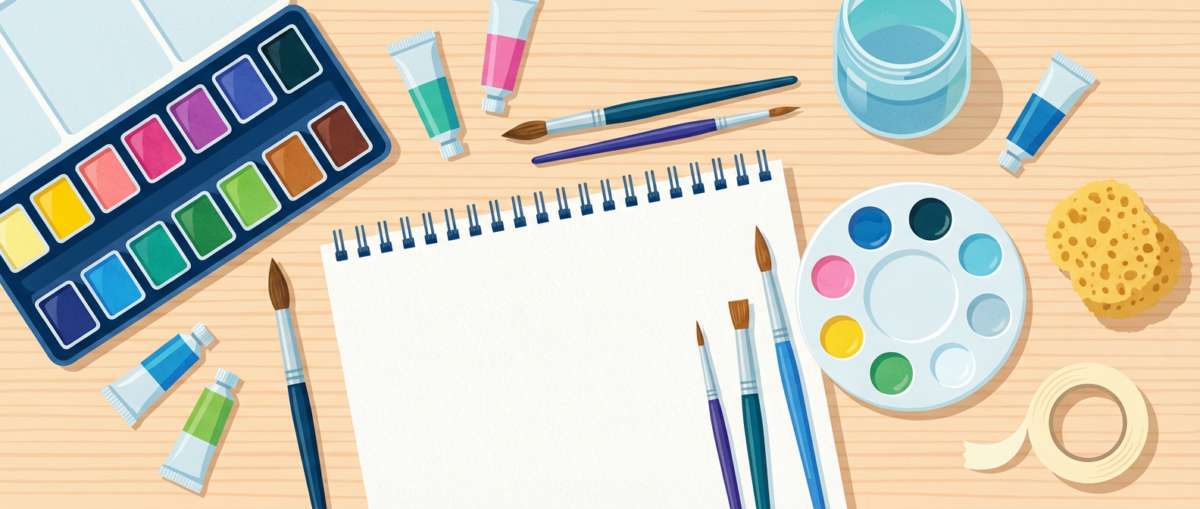
Walk into any art supply store and you’ll be confronted with glossy watercolor “starter sets” promising everything a beginner needs in one convenient package. These sets are masterpieces of marketing psychology, not artistic necessity. They typically contain dozens of tiny paint tubes in garish colors like “brilliant orange” and “magenta” that most painters will never touch, paired with brushes so poorly made they shed like a Persian cat in summer.
The real tragedy isn’t the money wasted on unnecessary supplies. It’s that these sets actively sabotage learning by overwhelming beginners with choices while providing subpar tools that make good technique nearly impossible. When your brush can’t hold water properly or your paint refuses to flow smoothly, you’ll blame your inexperience rather than your equipment. This creates a cycle where struggling artists buy more supplies hoping to solve problems that better initial choices would have prevented.
The industry profits from this confusion, but history tells a different story. When Turner was revolutionizing landscape painting, he worked primarily with earth pigments and a handful of reliable brushes. Winslow Homer’s glowing watercolors emerged from disciplined restraint, not an arsenal of synthetic colors. The lesson isn’t to reject modern innovations, but to understand that mastery grows from deep exploration, not buying more options.

The Three-Color Revolution You’ve Never Heard About
Here’s where I’ll lose half my readers: you need exactly three colors to begin watercolor painting seriously. Not twelve, not twenty-four, certainly not the forty-eight tube sets marketed to eager beginners. Ultramarine blue, burnt sienna, and cadmium yellow form what colorists call a “perfect triad.” These three pigments can mix virtually any color you’ll encounter in nature. Learning to combine them teaches color theory in ways that pre-mixed convenience colors never will.
This isn’t artistic snobbery talking. It’s practical wisdom gained from watching countless students struggle with mud-colored disasters because they grabbed the first green or purple from their palette instead of learning to mix it fresh. When you mix your own secondary colors, you understand their temperature, their opacity, their personality. You learn that the green mixed from ultramarine and cadmium yellow sings differently than one mixed from the same yellow and Prussian blue.
Professional colorists know this secret. Film production designers work from limited palettes to ensure visual coherence. Interior designers build entire room schemes around three foundational colors. The Impressionists revolutionized painting not by using more colors, but by understanding how a few colors could interact with light and shadow to create the illusion of infinite variety. Your grandmother’s quilt patterns, those geometric compositions that catch your eye across a crowded antique shop, work precisely because they explore endless variations within strict chromatic boundaries.
The Brush Heresy: Why Expensive Doesn’t Mean Better
The art supply industry wants you to believe that good watercolor brushes require animal hair harvested under specific lunar conditions from pampered Siberian sables. This is romantic nonsense that separates beginners from their money while making them feel inadequate when they can’t justify spending $200 on a single brush. The dirty secret? Some of the most expressive watercolor work in contemporary galleries comes from artists using synthetic brushes that cost less than a fancy coffee.
Modern synthetic brush technology has reached remarkable sophistication. High-quality synthetic filaments can hold water as effectively as natural hair while maintaining their point through hundreds of painting sessions. They’re also more forgiving of the inevitable abuse that beginning painters inflict through improper cleaning and storage. When Georgia O’Keeffe was developing her distinctive style in the 1920s, synthetic brushes didn’t exist. Yet she often worked with inexpensive bristle brushes that horrified her more traditional colleagues.
The real consideration isn’t the hair source but the brush architecture. You need one round brush capable of both fine detail and broad washes. Size 10 or 12 provides versatility that smaller brushes can’t match. A well-made synthetic in this size will teach you more about watercolor handling than a collection of expensive specialty brushes that encourage technique-hopping instead of skill development. Master painters throughout history succeeded because they knew their tools intimately, not because they owned the most tools.
Paper Politics: The Support That Actually Supports
Paper discussions in watercolor circles often devolve into brand loyalty that resembles wine snobbery more than practical advice. Artists develop passionate allegiances to specific manufacturers and paper weights, defending their choices with the fervor of sports fans. This misses the fundamental point: paper is your painting’s foundation, and like any foundation, its job is to support the structure you’re building, not to announce its own presence.
The essential requirement is weight, specifically 140lb (300gsm) minimum. Lighter papers buckle and warp when wet, creating pooling problems that destroy smooth washes and frustrate beginners who assume they’re doing something wrong. The surface texture matters less than you’ve been told. Hot-pressed, cold-pressed, rough. These variations affect the final appearance, but they don’t determine success or failure. Van Gogh painted some of his most celebrated watercolors on whatever paper he could afford, including cheap writing paper that would make contemporary artists shudder.
The real controversy should center on size. Art schools and instructional books typically recommend small formats for beginners, supposedly to reduce intimidation and material waste. This is backwards thinking. Small formats encourage tight, fussy painting that fights against watercolor’s natural fluidity. Working larger, 11×14 inches minimum, forces you to use broader gestures, embrace happy accidents, and develop the confident approach that makes watercolor sing. When you’re cramped into a 6×8 inch format, you’re essentially learning to paint miniatures, not watercolors.
The Palette Conspiracy: Why Your Mixing Surface Matters More Than Your Paint
Most watercolor advice focuses on pigments while completely ignoring the palette, treating it as a mere container rather than an active participant in the painting process. This oversight reveals a fundamental misunderstanding of how watercolor actually works. Your palette isn’t just storage. It’s your mixing laboratory, your color memory, and often your best teacher about how pigments behave in different combinations and concentrations.
Disposable paper palettes, those tear-off sheets beloved by manufacturers, work against watercolor’s essential nature. Watercolor pigments perform best when they’re given time to dissolve properly, when you can return to partially dried mixtures and reactivate them with fresh water. Paper palettes absorb moisture, change the color temperature of your mixes, and encourage wasteful painting habits because they make cleanup too easy. You’ll learn more about color mixing in one week with a proper palette than in months of fighting absorbent paper surfaces.
A simple ceramic dinner plate works better than most commercial palettes. The white surface shows true color relationships without the subtle color shifts that plastic palettes introduce. The non-absorbent surface keeps your paints workable longer and allows for the kind of spontaneous mixing that creates those magical color transitions that make watercolor painting addictive. Picasso reportedly did some of his blue period work using dinner plates as palettes, not from poverty, but because he understood that the right working surface supports creative flow rather than hindering it.
These tool choices aren’t just practical decisions. They’re creative philosophy made manifest. Every brush you choose, every color you squeeze onto your palette, reflects assumptions about how art happens and what kind of painter you want to become. What other essential tools have you discovered that contradict conventional wisdom? What supplies have you abandoned that everyone else swears by?