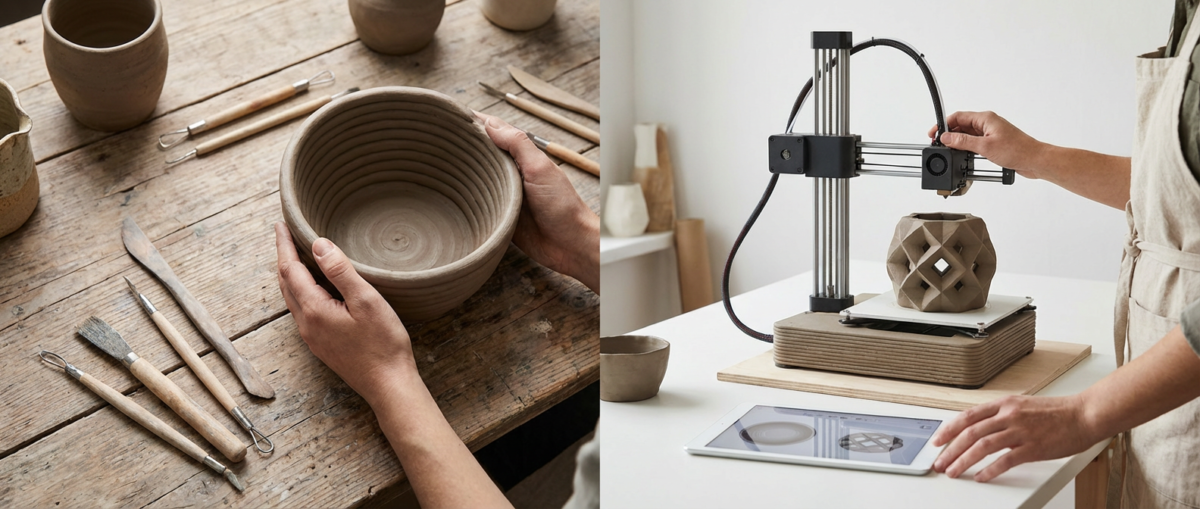
Last week I watched a potter at the downtown farmers market throw a bowl that would make any Ming Dynasty craftsman weep with envy. Her hands moved with the same fluid precision I’ve seen in 2,000-year-old Japanese tea bowls, yet she was using techniques that most ceramic curators would dismiss as “too accessible” or “commercially driven.” This disconnect between what we celebrate in museums and what we overlook in contemporary practice reveals something troubling about how we value ceramic art.
The reality is that many of today’s working potters have mastered ancient techniques with an intimacy and daily practice that surpasses the occasional masterpiece we’ve elevated to museum status. While we venerate the rarity of surviving historical ceramics, we’re missing the revolution happening in studios across the world where traditional methods are being refined, adapted, and frankly, perfected.
The Raku Revival That Museums Missed
Walk into any contemporary ceramics studio and you’ll likely find someone experimenting with raku firing, the 16th-century Japanese technique that involves pulling red-hot pottery from kilns and plunging it into combustible materials. What’s fascinating isn’t just that this ancient method survived, it’s how modern practitioners have pushed it beyond its original ceremonial tea bowl origins into sculptural territory that would have been unimaginable to its creators.
Paul Soldner revolutionized raku in the 1960s by introducing Western glazes and larger forms, but today’s potters are taking even bolder leaps. They’re using recycled materials for reduction chambers. They’re experimenting with digital temperature monitoring for more precise control. Some are creating installation pieces that sprawl across gallery walls. The technique remains fundamentally unchanged, rapid cooling, dramatic reduction, unpredictable results, but its applications have exploded into contemporary art practices that museums are only now beginning to recognize.
The irony is that while we treasure the handful of historical raku pieces that survived centuries of fragility, we often overlook the thousands of contemporary works that demonstrate a deeper understanding of the medium. Modern raku artists aren’t just recreating ancient methods. They’re pushing the chemical and physical boundaries of what clay bodies and glazes can withstand, creating work that’s technically superior to many historical precedents.
Pit Firing’s Unexpected Contemporary Renaissance
Even more dramatic is the resurgence of pit firing, humanity’s oldest ceramic technique. For thousands of years, potters buried their work in earth kilns, using organic materials like seaweed, banana leaves, and cow dung to create the smoky, earth-toned surfaces that we now associate with “primitive” pottery. Contemporary ceramicists have reclaimed this method not as historical reenactment, but as sophisticated surface treatment that achieves effects impossible with modern kilns.
Maria Martinez’s famous black-on-black pottery from San Ildefonso Pueblo demonstrates how traditional pit firing techniques can produce work that transcends any simple historical categorization. Her mastery of reduction firing in outdoor kilns created surfaces with such subtle variation and depth that they rival any contemporary gallery piece. Yet because her work emerged from continuous cultural practice rather than fine art training, it took decades for museums to recognize its worth.
Today’s pit firing practitioners are building on this foundation with scientific precision that ancient potters couldn’t have imagined. They’re documenting temperature curves. They’re experimenting with specific organic materials for predictable color results. They’re combining traditional reduction methods with contemporary forming techniques. The results are pieces that honor ancient wisdom while pushing ceramic art into entirely new aesthetic territory.
Why Ancient Coiling Techniques Outperform Modern Throwing
Here’s where I’m going to make ceramics purists uncomfortable: hand-building techniques like coiling often produce structurally superior and more expressive work than wheel throwing, despite our cultural bias toward the “mastery” implied by centering clay on a spinning wheel. The coiling methods perfected by Ancestral Puebloan potters over centuries allow for wall thickness variation, asymmetrical forms, and organic shapes that wheel throwing simply cannot achieve.
Contemporary artists like Betty Woodman understood this intimately. Her large-scale ceramic sculptures combined ancient coiling and slab-building techniques with bold contemporary glazing and painting. She could create forms that swelled and contracted, twisted and curved in ways that challenged everything we think we know about ceramic possibilities. Her work proved that “primitive” hand-building techniques could produce complexity and sophistication that mechanical throwing methods constrain.
The speed argument for wheel throwing falls apart when you consider durability and expressiveness. A coiled pot by Lucy Lewis takes longer to construct but can last centuries without cracking, while many wheel-thrown pieces fail within decades due to stress points created by the throwing process. Contemporary hand-builders are rediscovering these structural advantages while developing hybrid techniques that combine ancient wisdom with modern materials science.
Where Traditional Glazing Chemistry Beats Modern Formulation
Perhaps nowhere is the superiority of ancient techniques more evident than in glazing, where traditional methods often achieve effects that modern chemistry struggles to replicate. Chinese celadon glazes developed during the Song Dynasty created depths of color and surface quality that contemporary potters spend lifetimes trying to match. The key difference isn’t just the specific mineral content, it’s the understanding of fire, atmosphere, and timing that can only come from generational knowledge transfer.
Shoji Hamada’s approach to glazing exemplified this traditional mastery applied to contemporary forms. Rather than relying on precise chemical formulations, he developed an intuitive understanding of how local clays, wood ash, and firing conditions interacted to create his signature warm, earthy surfaces. His glazes achieved complexity through imprecision, variations that computer-controlled kilns actively try to eliminate.
Modern ceramicists who embrace this uncertainty often produce the most compelling work. They’re learning that ancient potters understood something we’ve forgotten: the beauty lies not in controlling every variable but in creating conditions where serendipity can flourish within skillful constraints.
The False Hierarchy We’ve Created
The real issue isn’t that ancient techniques are superior to modern methods, it’s that we’ve created an artificial hierarchy that privileges innovation over mastery and individual expression over cultural continuity. We celebrate ceramic artists who “break boundaries” while dismissing traditional practitioners who’ve achieved levels of skill that take generations to develop. This bias blinds us to the reality that the most interesting contemporary ceramic work often emerges from deep engagement with historical methods.
The next time you encounter a potter working with traditional techniques, resist the impulse to categorize their work as nostalgic or conservative. Instead, look for the ways they’re pushing ancient methods into new territory. You might discover that the future of ceramics isn’t about abandoning the past but about understanding it deeply enough to transform it. What traditional ceramic techniques have you encountered that challenged your assumptions about old versus new?